In Honor of the “Super Moon” – Identifying and siding the lunate

"All in all, pretty meh" proclaimed astronomers.

“All in all, pretty meh” declare  astronomers. “Would have been better to call it a “Mediocre Moon”.

Last week marked the arrival of the “super moon”, the rare coincidence of a full moon phase with the point in its orbit at which the lunar body is closest to the Earth. In order, no doubt, to stimulate public interest in astrophysics and astronomy, researchers have enthusiastically proclaimed that “the real size difference isn’t big enough to notice” and “it won’t fill the sky”. Astronomers: The killjoys of Science!

Left: Left lunate, view from the scaphoid. Right: Crescent Moon, view from Earth, presumably.

Left: Left lunate, view from the scaphoid, palmar is up.
Right: Crescent Moon, viewed from  the Earth, presumably.

However, in order to rectify their dearth of exuberance, I give you a post on the lunate, one of the easiest carpals to identify and side. In sharp contrast to the super moon, the lunate is shaped like a crescent moon, and is accordingly difficult to confuse with any of the other carpals. Though one could argue that the scaphoid demonstrates a similar curvature, the lunate is much smaller and lacks the distinctive proximal concavity (for articulation with the capitate) and distal convexity (for articulation with the radius) of the scaphoid. Also, as we’ve discussed previously, the scaphoid is easily identifiable because it looks like a snail

Left: Croissant Right: Left lunate, articulation for the triquetral highlighted in yellow.

Left: Croissant
Right: Left lunate, articulation for the triquetral highlighted in yellow.

Siding Tips:  When you find a lunate, orient it so that its most convex and rugose surface points away from you – rather as if it was a croissant you were about to tuck into. I must emphasize that the pastry metaphor isn’t really straying from the lunar theme, since  etymologically speaking, croissant and crescent stem from the same root. Once oriented thusly, make sure that the surface containing the articulation for the triquetral is facing up. This is easy to differentiate from the less well-defined, more rainbow-shaped  arc of the scaphoid articular surface, for the triquetral articulation is small, flat, well-delineated and half-circular – as indicated in yellow in the photo above. This articulation will fall to the side the bone is from!


Original Photos found here: 1  2 &  3 & 4 & 5 .

Posted in Carpals, Hand, Osteology, Siding Tricks | Tagged , | 2 Comments

Feeling Shafted? Tips for identifying humeral shaft fragments

I’ve been spending a lot of time lately sitting cross-legged on the floor of my office, refitting long bone shafts. This pastime  generally involves me hunching over a tray like a cranky oracle, brows furrowed, staring suspiciously at the bones for vast amounts of time. Occasionally I’ll spot a match and swiftly grab at seemingly random fragments while uttering an unconscious bark of triumph. And yes, the Spanish colleagues I share my office with are likely concerned about both my sanity and their safety. But I digress.

During most osteology quizzes, shaft frags tend to have a ‘tell’ – they come complete with distinctive muscle attachments like the soleal line or deltoid tuberosity, or they have handy nutrient foramina that  allow you to orient the bone. In the real (read: archaeological) world, however, such ‘tells’ can be few and far between, so oftentimes shafts must be identified based solely on their shape in cross-section. This can be particularly tricky as both the shape and diameter of long bone shafts change gradually along a superior-inferior gradient. While most textbooks give detailed written descriptions of such changes in cross-sectional form, visual depictions are harder to find – google image search “humeral shaft cross-section” and you’ll see what I mean. Little of use for the beleaguered novice osteologist. And when you do find cross-sectional drawings, they tend to derive from only a single part of the bone.

Accordingly, I spent a little bit of time sketching the cross-sectional shape of a fragmentary humerus from my dissertation collection and took a photo of it so you can see where exactly on the shaft the cross-sectional shape comes from. I  then translated my sketches into what we will term ‘charmingly primitive’ paint outlines, a la hyperbole and a half. Now you too can have a handy map of the humerus!

Bone Broke – Tips for identifying humeral shaft fragments

Here’s a link to a PRINTABLE PDF if that’s more your style. Happy refitting!

Post-Script: Hahaha a “handy” map of the humerus. That pun wasn’t even intentional! I crack myself up sometimes. And on that note, time to actually go enjoy my Friday, a practice that the Spanish term  “cervezas“.

Posted in Long Bones, Osteology | Tagged , , | 3 Comments

Want to impress your friends at parties?* A guide to quickly siding the patella.

Please enjoy this old school ANTHRBIO 477 notebook drawing

Please enjoy this old school ANTHRBIO 477 notebook drawing.

While working with the ca. 5,000 year old Copper Age human remains that I’m studying as part of my dissertation research, I’ve noticed that the patella tends to preserve fairly well. The patella is up there on my list of favored bones (still losing out to some of the tarsals and carpals), because it’s so easily recognizable and easy to side. It is also the largest sesamoid bone in your body, so unlike some of the other sesamoid bones, could never be confused with a subadult lunate. Bonus points to the patella!

A few quick tips: The patella is rougher anteriorly (frankly, I find the vertical striations so characteristic of the front of the patella to be one of the most distinguishing characteristics of the bone) and smooth posteriorly, where it articulates with the medial and lateral condyles of the distal femur.  Superiorly it presents a relatively horizontal edge with rounded corners, while the apex, or inferior portion of the bone is noticeably pointed, leading to the bone’s distinctive triangular shape. On its posterior aspect, the  lateral articular facet is larger than the medial articular facet.


The trick: If you have a relatively complete patella, orient it on a table in front of you so that the posterior surface is flat on the table and the anterior surface is facing up. Then, rotate it so that the superior-most portion is closest to you and the apex is pointing away from you. You could also think about it this way: if you propped your leg up on the table in front of you, and plucked your own patella from your leg, setting it immediately down on the table, it would be in this position. When thus oriented the patella will fall to the side that the bone is from.

I realized, long after I learned this trick (I am, quite clearly, not one of the brighter graduate students in our department), that the reason the bone falls to the side it’s from is because the lateral articular facet is larger than the medial articular facet; you could really just examine these in order to side the bone. Importantly, however, this method is a lot more fun because it’s hands-on AND you can impress unwitting by-standers with the equivalent of an osteo magic trick.

* Some day, if you really want to impress your friends at parties, I’ll give you the rundown on how to open a bottle of beer using a trowel (as taught to me by this illustrious individual). This invaluable skill has come in handy more than once over the course of my participation on various and sundry field projects.

Sagres. Nectar of the Iberian Gods.Original Gray’s image found here.

Posted in Osteology, Patella, Siding Tricks | Tagged , | Leave a comment

OsteoMenagerie 3: The petrous portion of the temporal bone

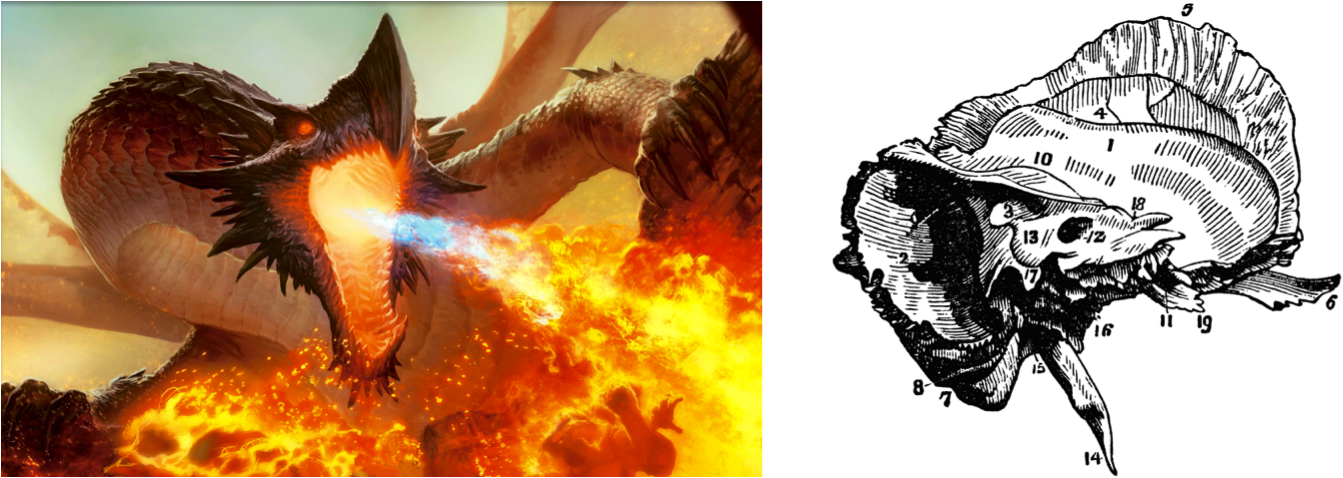
The petrous portion of the temporal bone provides passage for the facial (VII) and vestibulocochlear (VIII) nerves, houses some of the body’s most delicate organs of hearing (including the auditory ossicles) and is one of the densest bones in the body. As such it tends to be one of the better preserved cranial bones. You’re likely to come across it even at  sites where most cranial bones are highly fragmented or commingled, and you’ll definitely come across it on bone quizzes if your instructor has any sort of penchant for archaeology. It’s  important to be able to side it, particularly when isolated, as taphonomy is normally far kinder to the petrous portion of the temporal than it is to the squamous or mastoid portion. Personally, when I look at the petrous portion in posterior view, I see a dragon. Maybe it’s all the recent uproar about GoT (if you have no idea what I’m talking about, watch this trailer, it’ll get you piloerect in no time), but I think there’s something to the visual metaphor. To wit:

See also: LOTR, Harry Potter, How to Train Your Dragon, Reign of Fire, etc, etc.

Left: Right temporal bone (endocranial view).
Right: Dragon.

So if you’re looking at a temporal bone in posterior view, you’ll see the petrous portion stretching anterio-medially towards the midline of the body. The internal auditory meatus (as indicated in the photo from White & Folkens’ HBM, above) is the dragon’s “eye”, while the carotid canal that opens inferiorly and medially is the dragon’s “mouth”. The large and smooth IAM foramen is only visible posteriorly, so if you examine the cranium from this aspect, the left temporal “dragon” and right temporal “dragon” appear to be facing each other – or, if it’s mating season, appear to be breathing fire at each other in a breath-taking demonstration of intrasexual competition, as in the depiction above.

Dragons are cantankerous creatures, aren't they?

Left: Dragon.
Right: Left temporal bone, (endocranial view).

Siding Tips: If you’re having trouble orienting an isolated petrous portion, one trick I always use is the position of the superior petrosal sulcus. This is a narrow but palpable groove that runs along the superior-most part of the petrous portion towards the squamous portion of the temporal bone (from the tip of the dragon’s snout along his entire head, if you will). Depending on how much of the bone you have, you can also use the position of the sigmoid sulcus (identified in the first photo by White), which is going to sit posteriorly and laterally relative to the petrous portion. It curves around the “neck” of the dragon – you can think of it as an excellent place to put a collar – or, you know, a transverse sinus.

Finally, let’s reward ourselves for learning about the temporal bone by taking a minute to celebrate the truly astounding grasp of the concept of evolution demonstrated by the masterpiece that is Reign of Fire. Don’t even get me started on why the inhabitants of a remote fortress in NORTHERN ENGLAND are practicing a form of subsistence farming that relies heavily on the cultivation of TOMATOES :

Original images found here: 1 & 2 & 3. First temporal bone photo from White & Folkens’ Human Bone Manual (2005), p. 97,

Posted in Cranium, OsteoMenagerie | Tagged , , | Leave a comment

Taylorism and Teaching

Would you make an efficient assembly line worker? It only costs $150 to find out!

Would you make an efficient assembly line worker? It only costs $150 to find out!

Alternate Title: “Why you should never use an anthropologist as a participant in your research study“.

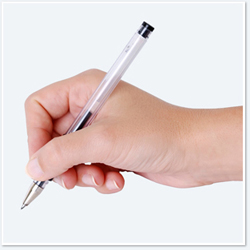
I recently participated in a Kinesiology study that tested reaction times between two different sets of individuals. Despite my frequent lack of coordination, I was actually placed in the ‘healthy’ or “control” group. One key task participants were asked to perform involved the use of a Purdue Board to quantify  fine motor dexterity. The board itself is simple: three different types of small metal objects (pins, collars and washers)  are housed in four circular depressions on the top of the board, and two lines of peg holes run the length of the board. Subjects are given a set amount of time (usually 30 seconds to one minute) and asked to place either pins or a specific sequence of objects (e.g. washer, pin, rod) in the holes, using either one hand or both hands depending on what is being tested.

Right off the bat (or, more accurately, right off the peg) I found the results of the test to be intriguing. You’re asked to repeat each task several times to control for the learning curve, and patterns emerge immediately: your dominant hand always fills in a few more pegs than your less-dominant hand, for instance, and your speed clearly increases with experience. While chatting with the researcher collecting the data, I also learned that the test was originally developed to quantify the skills of factory-workers; there have been times in the past when your job security could ride on the results of playing this “game”!  Additionally, he told me that certain groups of people tend to perform particularly well – sewing machine workers were cited as the most adept profession. Finally, women are generally ‘better’ at the peg board test than men.

I  of course immediately began to dream up evolutionary explanations for this sex-related difference in performance (Why yes, Gould & Lewontin, I’ll take my spandrels functional, thank you), until the researcher immediately followed up with “….because women’s hands tend to be smaller than men’s”. Since the peg board requires an intricate precision grip, best managed by smaller fingers, this explanation made intuitive sense. However, adaptationist fallacy aside, I was still intrigued by the possibility of using the game as a teaching aid. These peg boards could easily be used as a tool for teaching students about how biological anthropologists develop hypotheses, control for specific variables, collect data, and then reject or produce alternate hypotheses as a result of this process.

precision_gripStage One: If you can get a hold of more than one Purdue board, you could divide students into groups and have them time each other and keep records of their performance in the various exercises (e.g. how many pegs or series of metal objects each individual placed each round). I find it easier to motivate students when you have them engaged in an activity, particularly if it’s competitive without being judgemental (e.g. if you’re bad at the peg board game, no one will mock you for it, whereas if you’re good at the peg board game, you can sit and bask in a misguided sense of superiority for an hour). I would recommend limiting students to using only their left hands, because then “sex” and “handedness” are two categorical variables they can examine relative to quantitative performance.

Stage Two: After initial data collection, have students compare their ‘scores’ and develop behavioral hypotheses to explain any disparities between individuals or between groups,  sharing these hypotheses as a class.

Stage 3: Afterward the hypothesis discussion, have students measure some of their hand dimensions using calipers (width of palm and distance from base of palm to tip of middle finger are likely good dimensional measures), and re-evaluate their orignal behavioral hypotheses in light of these new results. Based on my discussion with the kinesiology researcher, I would expect a strong negative relationship between hand size and performance, independent of sex. Part of this activity could also be a take home exercise, where students manipulate the class data and run very simple stats on it. All in all, in one fell swoop Purdue peg boards could be used to teach an important and interactive lesson about data collection, hypothesis development and hypothesis testing in science.

That would certainly be an interesting job application to read

Dear Kellogg Company, As you can see, I have long been familiar with what is justifiably one of your most popular products…

As an aside, I now know that if I don’t make it in academia, my performance on the Purdue board suggests I would qualify for any number of assembly line jobs. I wonder if Kellogg needs any new workers…and also what their employee discount is.

Original images found here & here. Thanks to my buddy Aaron Sandel for buying me all the poptarts in the picture to the left! Though admittedly, that particular adventure had nothing to do with the Purdue board study.

Posted in Teaching | Tagged , | 1 Comment

How to “Rock” your Prelims*

Figure 1: Cats are not a useful prelim aid.

I have a number of friends in grad school who are taking  prelim exams this month. Also called “comps” or “quals”, these comprehensive exams are a notorious crucible during students’ early years in the program. Depending on your department and subfield, prelims can range from a full day, closed-book onslaught that forces you to simultaneously remember the type of currency used in the Achaemenid empire, the evidence for language capacity in neanderthals and the intellectual history of middle range theory, to an open-book extravaganza lasting ten days and requiring you to write upwards of a hundred pages.  I remember little of my prelim semester except for barricading myself into my apartment, consuming vast quantities of yogurt-covered pretzels and Coke Zero, and clinging desperately to other members of my cohort whenever I saw them; their fatigued, shell-shocked countenances were the only expressions that mirrored my own sense of impending disaster. That entire autumn I felt like a character in an H.P. Lovecraft story – the sense of nauseating dread gradually increased over the course of the semester, becoming less and less bearable until it culminated in….a ferocious attack of unspeakably horrible trans-dimensional entities. By which I mean, that tricky question about chiefdoms we’d all been rather hoping to avoid.

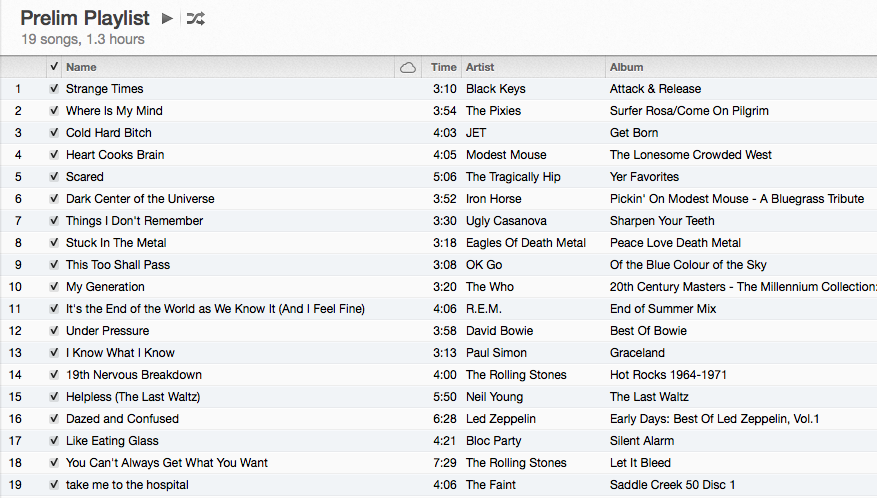
I’ve shared this before elsewhere, but this is the playlist I made that semester to musically represent my overall prelim experience. It’s actually a pretty defensible set on its own, and could, I think, be profitably used during any period that your adrenalin and cortisol levels are seriously spiking.

Prelim_Playlist

Figure 2: Music IS a useful prelim aid. See also: “Pretzel M&Ms”.

Years later, with far more knowledge and experience under my belt (Editor’s Note: purportedly…), I think that this is really the only song the playlist was missing.

* If you thought this was going to be a helpful post providing useful hints on how to DO WELL on your prelims, my apologies – you have come to the wrong place. Though I do strongly encourage the use of your favorite snacks as an inspirational tool, a strategy my friend Alice Wright has aptly termed “motif-food”. This is also a useful strategy when grading.

Posted in Grad School | Tagged , | Leave a comment

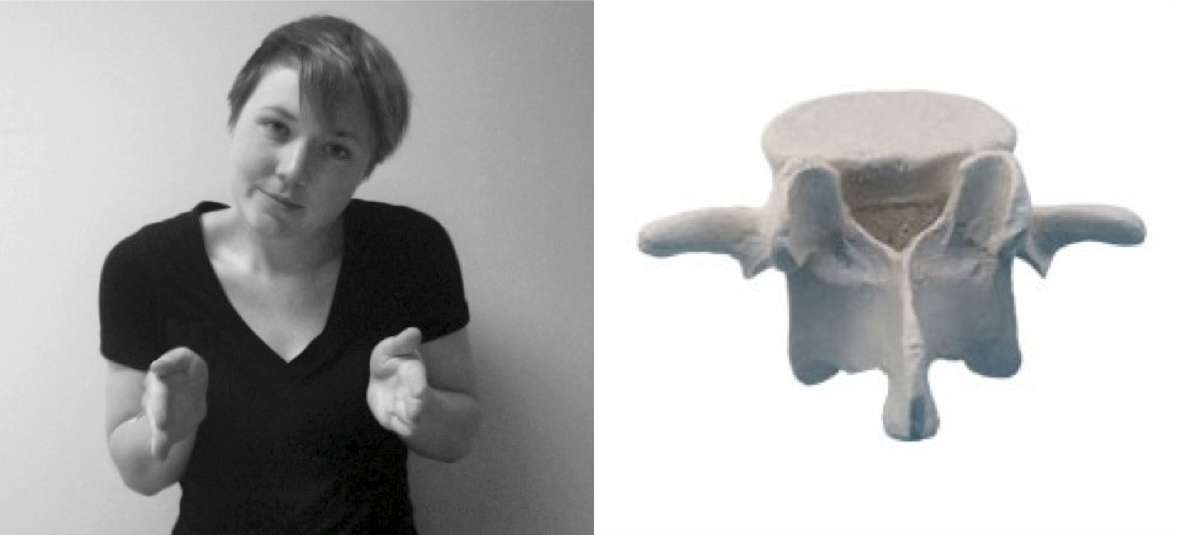
Cake or….Superior Articular Facets?

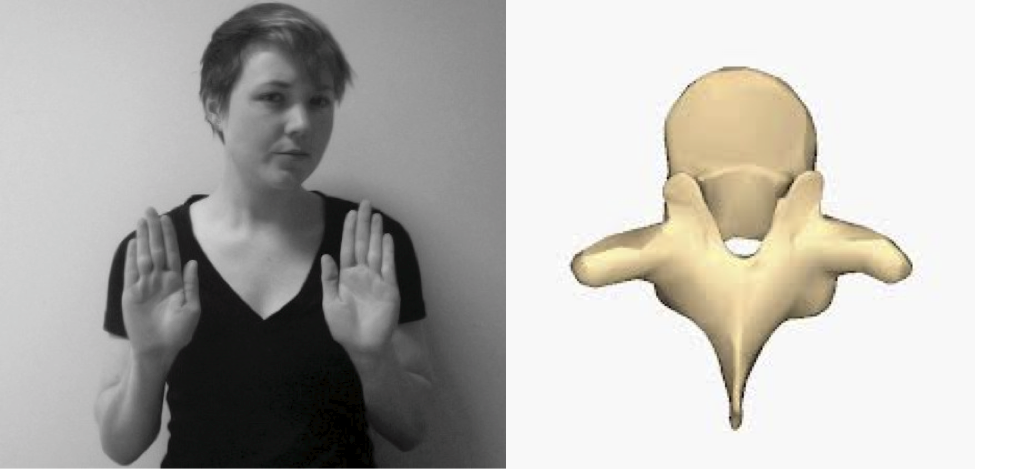
Superior Articular Facets: Thoracic Vertebra

Superior Articular Facets: Thoracic Vertebra

Excuse the Eddie Izzard reference. After learning this trick a few years back I’ve used it to teach students (or whoever is unfortunate enough to wander into the osteology lab when I’m in a didactic mood) how to identify vertebrae based on the orientation of their superior articular facets. To make it less formal, I rely on a useful little spiel involving hospitality and cake. The trick can also come in handy if you’re dealing with vertebral fragments.

If you’re not up on your vertebral features, the superior articular facets are the most superior…articular….facets on the vertebrae. Dammit osteologists, why you gotta be so literal all the time?  See above for a visual.

Now, once you’ve oriented your vert so that it’s in SAP and you’re looking at it in posterior view (in essence, looking at someone’s spine while standing behind them), identify the superior articular facets and examine their orientation; this is different for cervical, thoracic and lumbar vertebrae. Then, use the following dialogue to figure out which one you’ve got!*

1.  Be a good host/hostess.

"Would you like some cake?"

“WOULD YOU LIKE SOME CAKE?”

Notice how the orientation of the superior articular facets mirrors the orientation of my hands. Also, if I were really  a cervical vertebra I’d also have two transverse foramina bored into my shoulders, but I don’t care THAT much about teaching…

2. Play the polite guest.

"NO, I COULDN'T POSSIBLY!"

“NO, I COULDN’T POSSIBLY!”

You’ll have to suspend disbelief on this one; I’ve never in my life refused cake.

3. Finally relent and give in to your gluttony.

"WELL, MAYBE JUST A LITTLE PIECE..."

“WELL, MAYBE JUST A LITTLE PIECE…”

Again, my acting skills here are Oscar-worthy. I would never cut a slice of cake that small.

* As always, I’d recommend checking if anyone else is in the room before you do this, otherwise you sound a little bit like you’ve got Multiple Personality Disorder….Thanks to Danielle Trunzo (ASU) and Chelsea Himes (USC) for teaching me the original trick ages ago! Original images are 1 & 2 & 3.

Posted in Osteology, Vertebrae | Tagged , , , | 5 Comments

How I Feel about Hydrogen Peroxide

When prepping  animal bones, you need to submerge them in hydrogen peroxide. Through trial and error I have found that the compound seems to lose its potency over time, so you need refills for every batch of bones you soak. This means I spend a lot of my time as a carless, forcibly pedestrian graduate student lugging huge batches of H2O2 around campus. Accordingly, I tend to buy vast quantities of it when I get the opportunity to do so….

Original video found here.

Posted in Prepping Animal Skeletons | Tagged , | Leave a comment

OsteoMenagerie 2: The Scaphoid

Scaphoid-Snail, View 1

Left: Snail                                                Right: Left scaphoid, view from the radius-ish

For this week’s edition of OsteoMenagerie, we have the scaphoid, a bone of the wrist that clearly looks like a snail. Appropriately given last week’s OsteoMenagerie, another term for the scaphoid is the navicular, because it is similarly positioned to the tarsal bone of the same name. However, I find the doubling of names confusing, and the ‘s’ in Scaphoid is a “handy” (get it? get it?) reminder that this wrist bone bears a striking resemblance to a Snail.

When the hand is in SAP, the scaphoid is the most superior and proximal carpal, which reminds me – I have a useful mnemonic for remembering the order of the carpal rows that I’ll share soon! Additionally Wikipedia notes that it is about the size of a cashew, which makes me never want to eat cashews again, frankly.

Scaphoid-Snail: View 2

Left: Left scaphoid, view from capitate                                     Right: A different snail

Siding Tips: While this may make me a bad anatomist (Editor’s Note: It does make her a bad anatomist), when I’m working with whole carpals I rarely rely on their anatomical relationships, but instead use cheap tricks to identify and side them. Once I know that I’ve got a scaphoid, I orient it so that the tubercle is the “head” of the snail and the smooth indentation for the capitate is facing me. Whichever side of the snail’s head the shell falls on is the side the bone is from. In the drawing above, the bulk of the “shell” falls to the left of the snail’s head when the smooth indentation for the capitate is facing the observer, so the bone is from the left. If you doubt me (or find my logic confusing), verify with White & Folkens’ HBM, p. 229.

Original images found here: 1 & 2 & 3.

Posted in Carpals, Hand, OsteoMenagerie, Siding Tricks | Tagged , | 4 Comments

OsteoMenagerie I: The Navicular

I find that students react to the bewildering variety of bones in the human body with a greater amount of aplomb when you explain things using animal metaphors. I’ve always found some of these visual parallels impossible to unsee after discovering them, so I’m kicking off a series of posts intended to jazz up whole-bone osteology lessons. Fun for the whole family!

Navicubear

Left: Ursus maritimus.                                                              Right: Left navicular, distal view.

Siding Tips: If you have a whole navicular, remember that the head of the polar bear (e.g. the single facet for the first cuneiform) is distal, and will face medially. Alternatively, since we have a navicular in each foot, if you’re looking at someone in Standard Anatomical Position, these tarsal “bears”are going to be facing inwards towards eachother. Or, if you’re equal opportunity when it comes to spotting osteo-fauna, there’s also a head-shaped knob in proximal view (just medial to the facet for the talus), and that’s going to face medially too – see below!

Left: Left Navicular, Proximal View. Right: Ursus maritimus.

Left: Left Navicular, Proximal View.                                           Right: Ursus maritimus.

Original images sources 1 & 2 & 3 & 4.

Posted in Foot, OsteoMenagerie, Siding Tricks, Tarsals | Tagged , | 6 Comments