Birthday Bones

Los Morteros

This past weekend I took a hike in the Sierras de Jaén to celebrate my birthday, figuring that a day spent outside in the fresh air would be gentler on my liver than my usual celebratory exploits. Gasping for breath after hauling my suddenly anvil-heavy body up yet another series of steep switchbacks I began to reconsider this perspective, but on the whole the trek provided an enjoyable way to avoid contemplating my ever-increasing age.

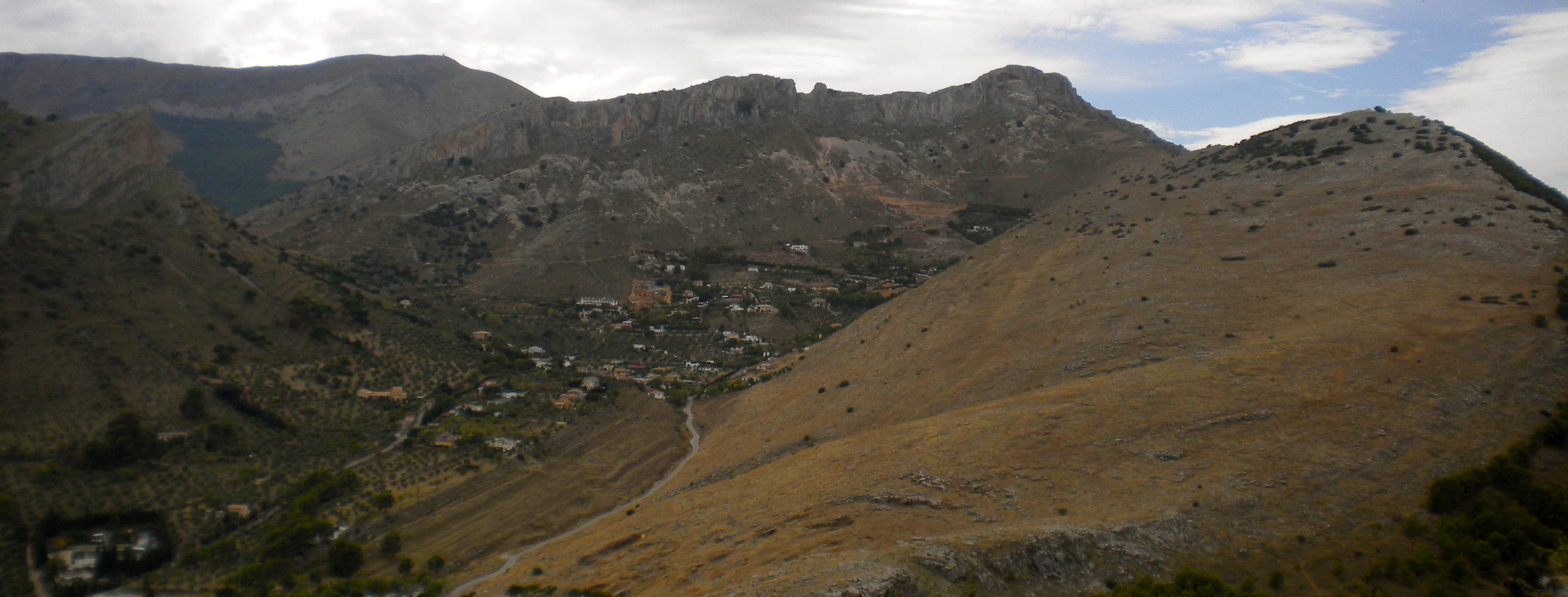
DSCN0289There are a series of summits just outside of the city limits that are accessible off of main roads as you cross into one of the outer barrios of Jaén. However, after a certain point the paved roads dwindle to gravel roads, the gravel roads dwindle to dirt paths, the dirt paths dwindle to goat tracks, and occasionally the goat tracks dwindle to nothing.  At such points, I focused on the few meters in front of me and kept climbing higher and higher, trying not to spend too much time looking down, because when I did I would see views like this:

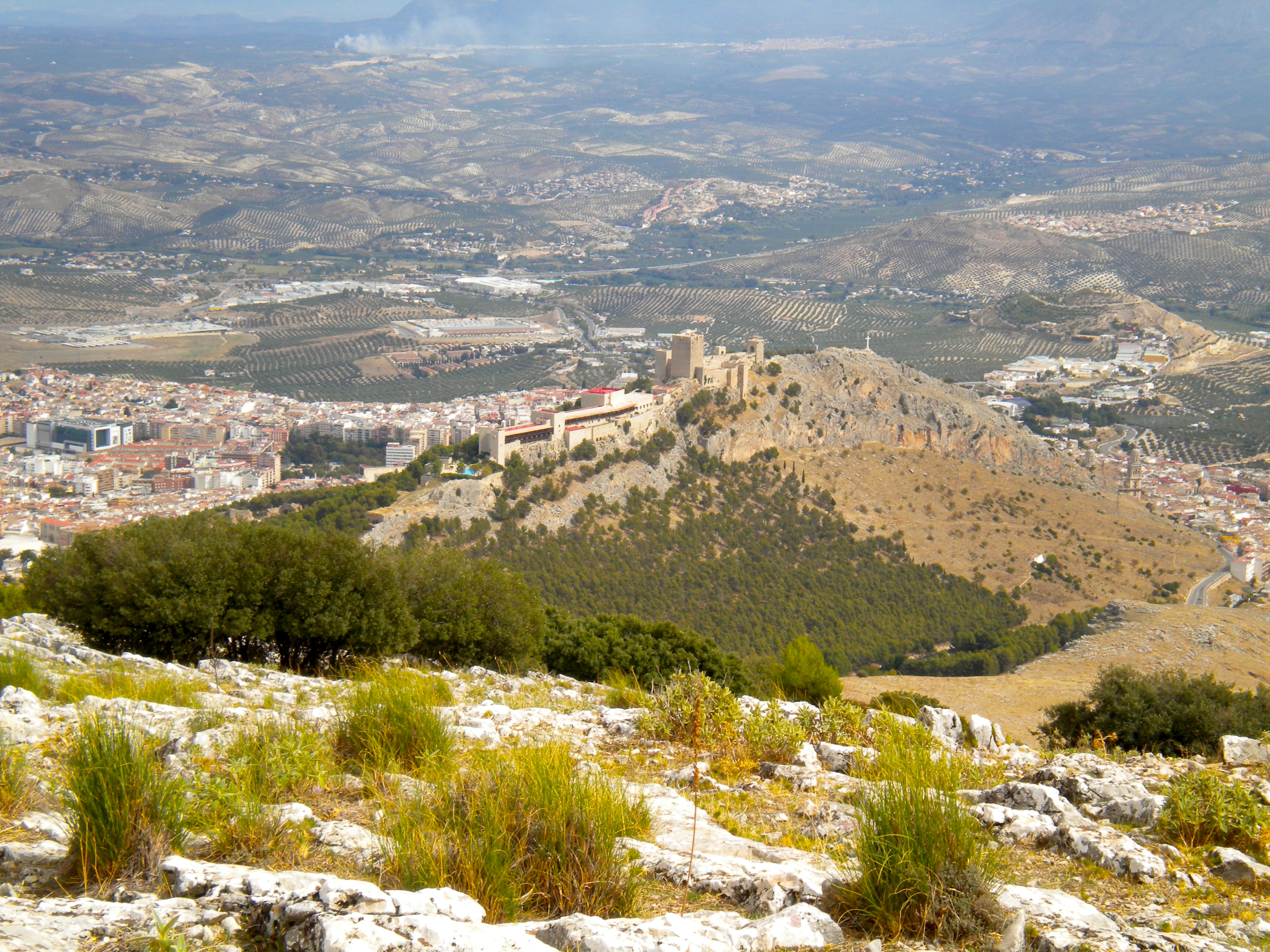
Thank God for goats.After summiting Los Morteros (the jagged dark gray ridge line visible in the first photo), I decided to return to the Castillo Santa Catalina via El Neveral, a gently domed peak that appeared to lead directly back to the fortress (appeared being the operative word here; a story for another time).

View of Castillo Santa Catalina from El Neveral
While springing from rock to rock as gracefully as an arthritic chamois, I looked down to find that the mountains had decided to grace me with a birthday gift:

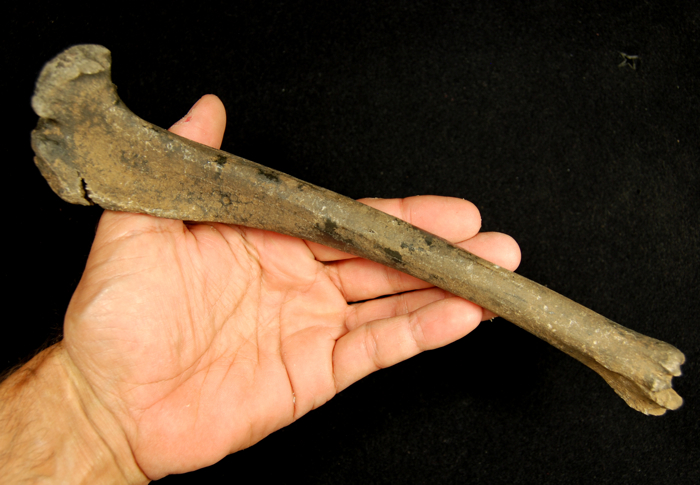
It's your birthday? How humerus!After the initial excitement wore off, I realized there might be more comparative specimens just lying around for the taking – possibly even a cranium. I explored the area for a few minutes, and while I didn’t find a cranium, I did spot a few other tell-tale splashes of white in the landscape, marked with arrows in the following photograph:

I found the bones fairly close to the summit, and while I’m not a zooarchaeologist, there’s a few things I was able to tell right off of the bat. My questions for you, intrepid and equal-opportunity osteologists, are as follows:

1. Given the local environment and the size of the specimens, what species would you guess these bones belong to?

2. Was this animal’s death recent? How can you tell?

3. Was this animal’s death the result of predation? How can you tell?

I’ve provided anterior and posterior views of the fragments of bones below, with a Euro for scale. For any zooarchaeologists reading, feel free to be as specific as possible as to species – I think I’ve got a pretty good idea of what these are, but I would love a chance to double-check!

Anterior viewPosterior view


Posted in Fauna, Long Bones | Tagged , , , , , , | 4 Comments

Pop Culture Osteology: The Blacklist

The Blacklist

I left the U.S. just before a number of the TV shows that I watch (e.g., anything that streams for free on Hulu) concluded their first seasons, meaning that I departed the country while at least three different plot lines had reached maximum cliffhanger saturation. NBC’s The Blacklist was one such show: the heroine’s marriage was in peril, her professional life was skirting the edge of disaster, and the antihero/hero/sometime villain was beset by nefarious and powerful foes.

Like Once, another one of my favorites, The Blacklist is ridiculous and nonsensical, although instead of applying the panacea of true love to untangle convoluted narratives, it relies far more heavily on a (likely misplaced) conviction in the omnipotence and omniscience of both the U.S. Federal Bureau of Investigation and the higher-end criminal underworld. It’s the sort of show where  helicopters arrive just in the nick of time, surprise gunshots ring out from behind the villain holding the protagonist hostage, and an apparently ubiquitous array of long-distance, high powered cameras manage to capture every illicit personal and professional interaction that could possibly be relevant to the current story arc.

S1.E12

“Magnify. Enhance. Can we move the helicopter two feet to the left?”

This all becomes osteologically relevant because during the final episode of season one, our dogged FBI task force is on the hunt for an escaped convict named “Berlin”, who is purported to be one of the deadliest and more powerful criminals in the world. While interviewing a prison guard who had interacted with the convict in the past, Agents Ressler and Keen are treated to an in-depth, if slightly mythologized, account of Berlin’s rise through the ranks of the criminal underworld. The hospitalized guard (played by the fantastic Peter Stormare, who you will likely recognize from Fargo), indicates that it all began when the criminal mastermind was imprisoned in Siberia.

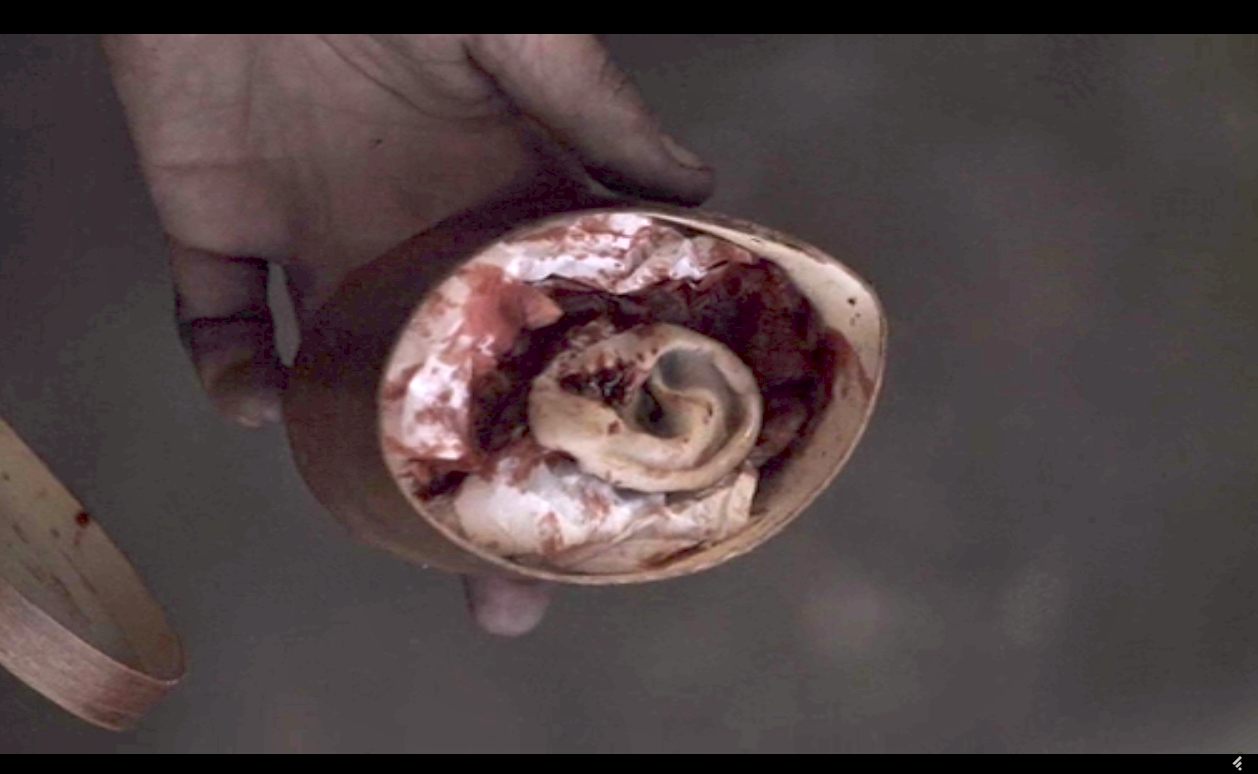
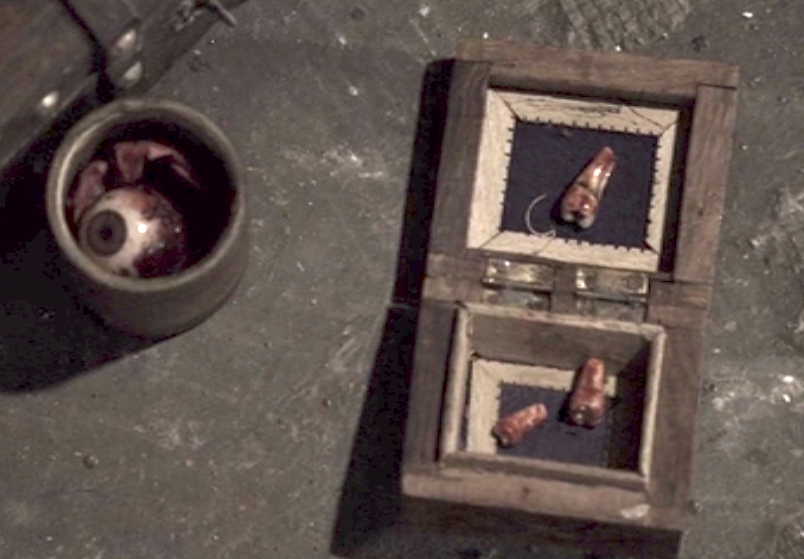
A former higher-ranking colonel in the Soviet army, Berlin had previously taken a brutal approach to individuals who did not toe the party line, and after his imprisonment his many enemies began to send him pieces of his daughter. Yes, that’s right, not missives from his daughter, but pieces of her. They started with an ear:

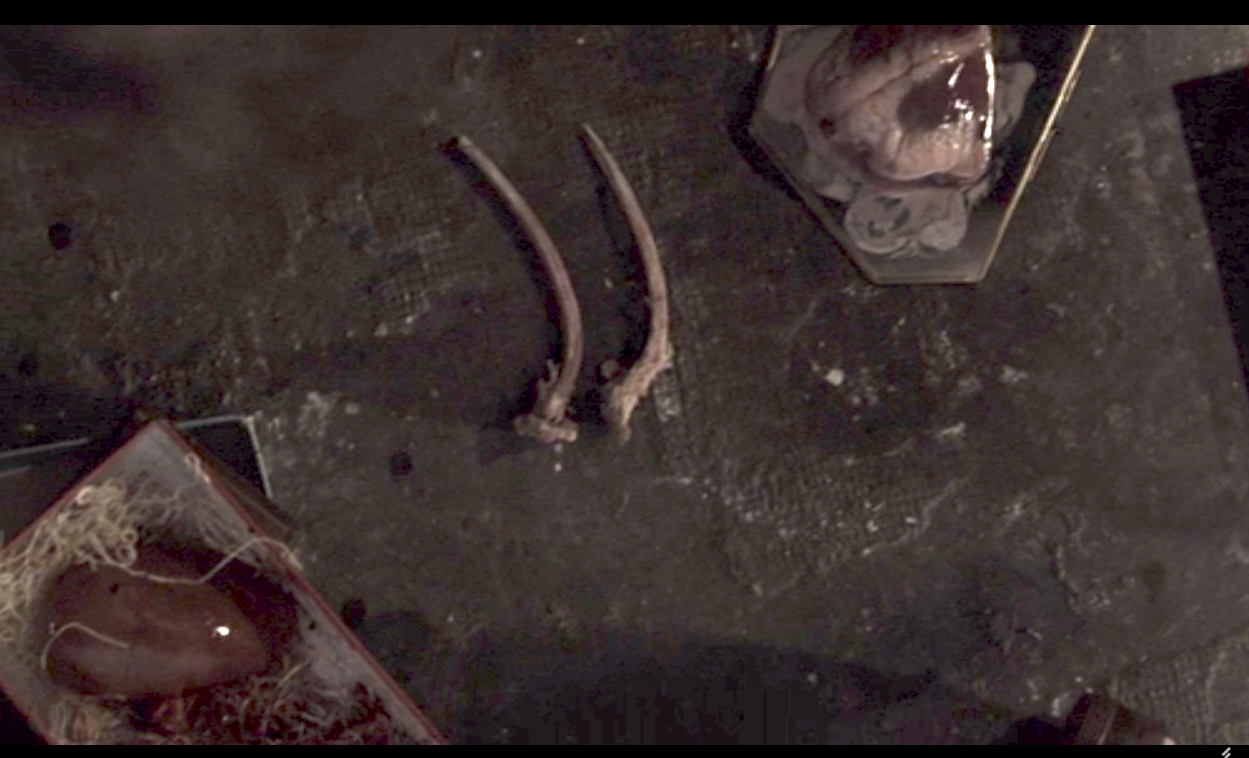
The first delivery...and then moved on to some packages that packed a more visceral punch (excuse the pun). Below we can see a few oddly shaped ribs – which I assume are lower ribs, given their size, relative lack of curvature, and the absence of clearly delineated heads – as well as what appears to be half a brain and a liver:

Ribs

before finally progressing to the dentition. Here, at least, I understand Berlin’s horror. Not only is the Soviet Siberian postal service jaw-droppingly lax about shipping regulations, but now he has to deal with LOOSE HUMAN TEETH? Having just analyzed some 3,869 human teeth, I feel his pain.

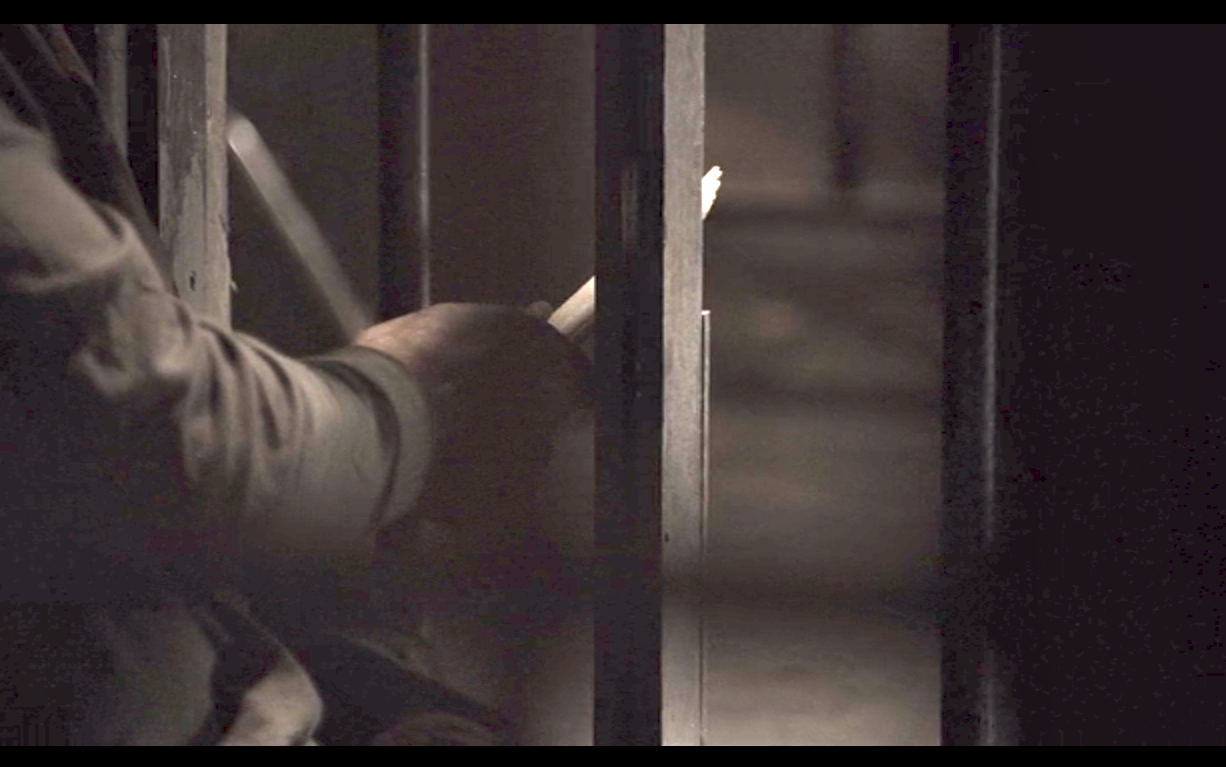
Teeth - the horror!These gory gifts understandably piqued our imprisoned colonel’s wrath, and he was able to transform his rage into a single-minded focus on escaping his imprisonment. As Peter Stormare explains “No one knows how he did it, but he did. Some say that he carved a knife from one of his daughter’s bones, and slaughtered all the men that had held him captive for so many years”.

Well that certainly seems like poetic justice. However, I do wonder, as a bioarchaeologist, which bone would be most appropriate for such an endeavour. Let’s see what Berlin used:

Judging by the width of the shaft and the size of the bone, this must be some sort of long bone. Considering that Berlin’s daughter was a young woman who grew up in the U.S.S.R (not a socio-historical context notorious for abundant access to subsistence goods), had been incarcerated at least once before (again, a context in which she likely would not have received adequate nutritional resources), and had likely been tortured before she died, I’m assuming that she would not have been a particularly robust individual.

[As an aside, while this line of reasoning no doubt seems terribly callous and glib, let us remember that this woman is a fictional character, invented solely to provide a plausible motive and backstory for an antagonist who was no doubt created largely to drive viewership in Season Two by creating a rivalry between criminal masterminds.]

Anyhow, let’s see if we can find a close-up of the bone. Based on its size in the screenshot above, it has to be one of the larger long bones, right? A humerus, tibia or femur? Let’s take a closer look:

Screen Shot 2014-10-03 at 8.52.07 PM

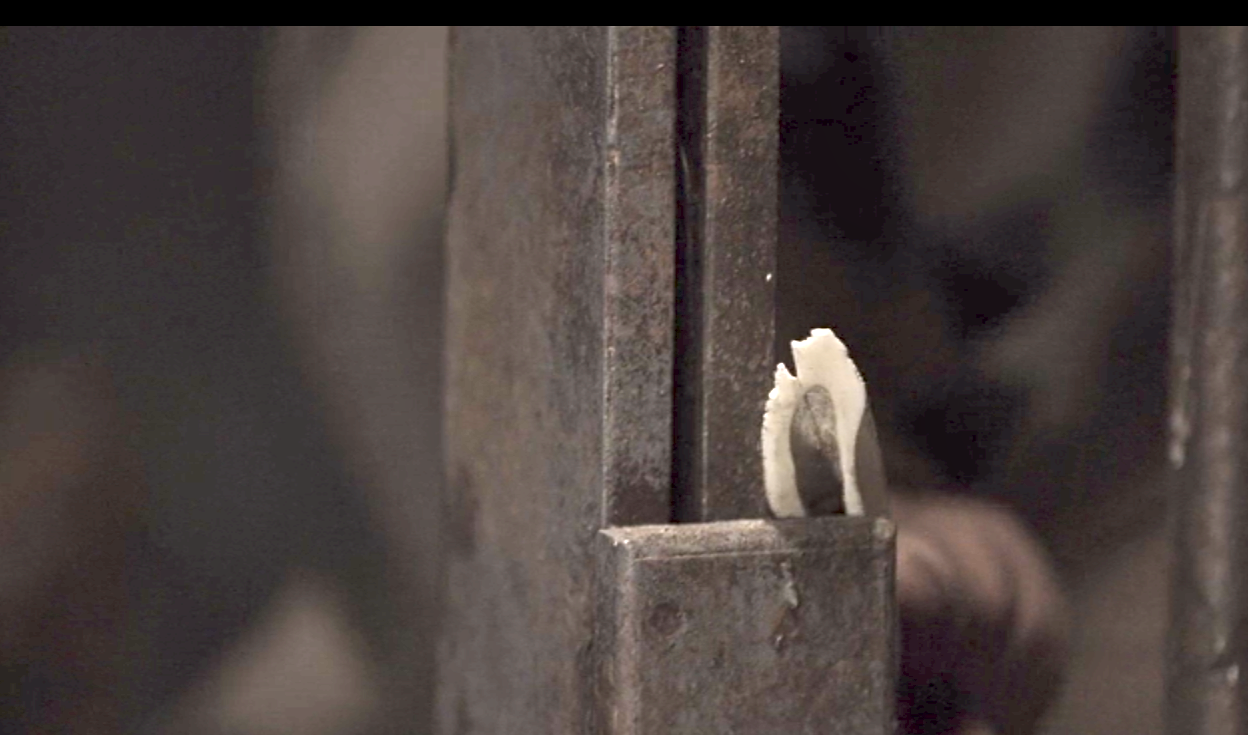
The show was gracious enough to give us a clear shot of the cross-section of the shaft while we witness Berlin sharpening his clever osteo-knife, and I must say, this curvature is troubling. I paused the episode when this first came up, because while the sharp, steep crest shown in the top of this photo could be an anterior tibial crest, the mediolateral dimensions of the rest of the shaft, and what would be the posterior border of the bone, are so narrow that I don’t think it can be a tibia. As you can see, tibial cross-sections, even mid-shaft, tend to be much broader posteriorly:

Tibial shaft cross sections

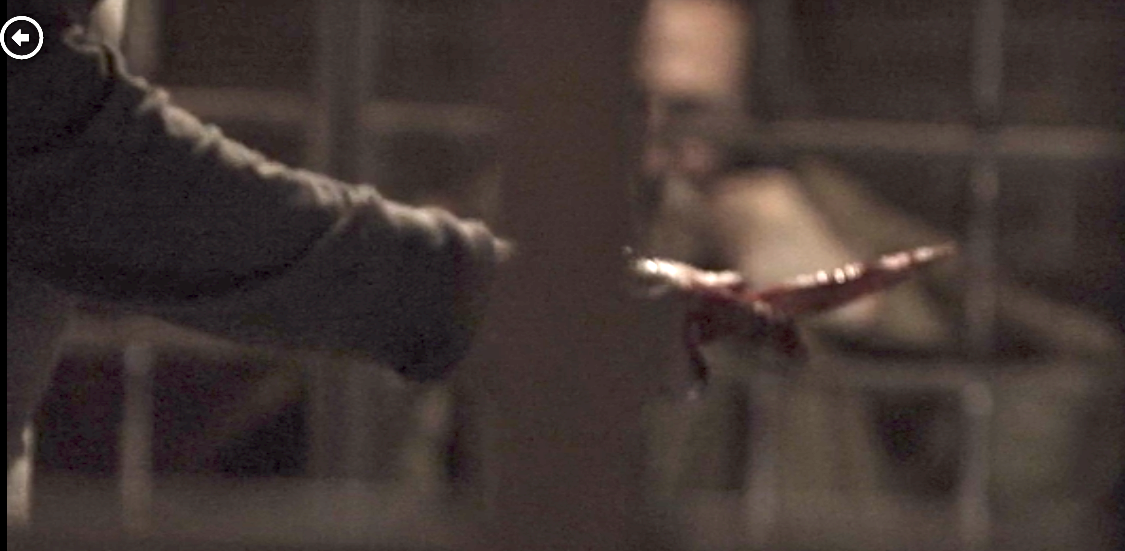
That sort of torquing and angular curvature that we see on Berlin’s bone knife is more characteristic of fibular shafts, but the bone in his hand is clearly too robust to be a fibula, and is particularly too robust to be a fibula if we’re talking about a young woman who has likely witnessed all sorts of nutritional setbacks and should be relatively gracile. Here’s another shot of the crest portion:

Screen Shot 2014-10-03 at 8.45.47 PM

And here, as Berlin merrily begins his first killing spree, we get a better sense of the dimensions of the entire shaft – too broad to be fibular, unless we’re talking a very large, very robust individual.

The only thing I could think of was that the long bone Berlin received might be faunal. Some of the larger ungulates, e.g. a large deer or elk, might have tibiae in this size class, and the anterior tibial crests for these sorts of animals does tend to be steeper and more pronounced than the crests on human tibiae (see below), though I’ve never seen one in cross-section.

Fossil Deer Tibia

However, it’s a difficult call based solely on the portion of bone observable during the prison break. Osteology readers, do any of you think this could be an oddly-shaped human tibial shaft? Or am I right in thinking there must be something strange going on? Either way, that Berlin may have begun his murderous rampage and life of crime after his enemies sent him faunal bones that were intended to look like the remains of his daughter is unfortunate.

Agent Keen is troubled
I agree Agent Keen, I too am troubled.


Image Credits:
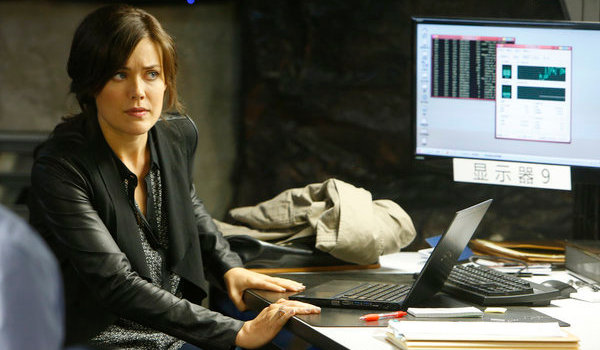
 The Blacklist header photo was found at deadline.com here, the second image of crack team members clustered around a computer was found at the Blacklist Wiki here, while the sketches of tibial cross-sections come from a University of Tokyo report, here. The deer tibia was pulled from fossilsonline here, and the image of Agent Keen looking troubled is from razorfine, here. All other photos are screenshots taken from S1.E22 of The Blacklist, which is the sometimes gory property of NBC, etc., etc.

Posted in Long Bones, Osteology, Pop Osteology | Tagged , , , , , | 2 Comments

Huerta del Manco

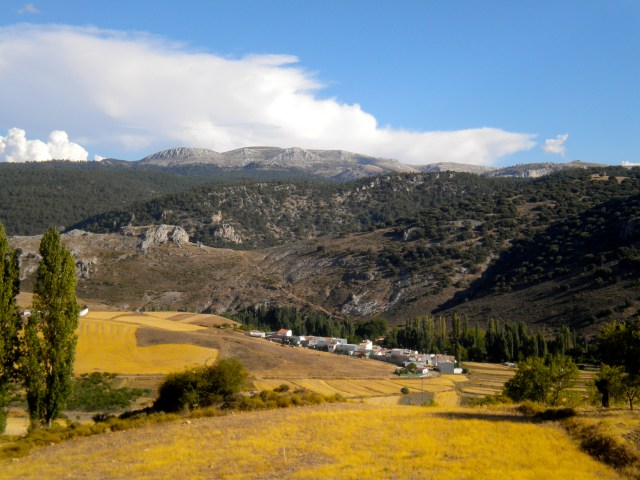
View on the road between Las Quebradas and Los Atascaderos

“It’s called Huerta del Manco,” she said in Spanish. “You know what that means?” “Huerta, si.” I told her. I’d come across the word before while translating archaeological texts and it was always used to describe orchards, groves or other types of cultivated land. “But… manco? No.” Rocío nodded, knowing it was time to resort to gestures “A manco is a person that has suffered from this”. She made a chopping motion over her left wrist.

I thought for a minute, melding the translations together in my head. “Orchard of the Amputees?” She grinned and started laughing as she could tell by my face that I’d figured it out.

Huerta del Manco is not the only unusual toponym in this part of Spain. My friend hails from the northeastern corner of Andalucía, a region famous for its exquisite mountain landscapes, which are protected in 2100 square kilometers of natural parks. These reserves are divided into three separate regions: Sierra de Cazorla, Sierra de Segura, and las Villas. In addition to “Orchard of the Amputees”, La Segura boasts such toponymic gems as Poyo Catalan (Catalonian Seat), Las Quebradas (The Broken Ones), and Santiago de la Espada (Santiago of the Sword).

The toponyms of La Segura We caught a large ALSA bus at the station in Jaén, spending three hours weaving through Jiennense campiña, the endless, rolling hills of olive groves so characteristic of the southern frontier of the province. Released from the museum, I was content to simply sit and gaze out the window, taking in the undulating terrain that rushed past us. I grew increasingly more excited as the occasional stand of pines broke the arboreal monotony of the continuous squat silver olive groves. I explained this to Rocío and she shook her head firmly, indicating that the campiña was all very well and good, but not really worthy of aesthetic note. “Wait until we catch the next bus” she told me, “wait for the mountains”. After three hours we reached the town of Puerte de Genave, where we boarded a smaller bus with a capacity of only sixteen people. The bus-driver gave me a curious look while we were loading up. “You going to Espada?” she asked skeptically, before Rocío jumped in assured her that yes, the strange, pale foreigner was already being supervised.

What with luggage, passengers, and a large cardboard box that appeared to contain an anvil based on the effort required to move it, it was a already a full ride. However, within minutes of getting on the road the small vehicle stopped once more, to admit a grandmother, mother and granddaughter onto a bus with no remaining seats. This proved no deterrent – the trio of fashionably dressed teenage girls behind us squished together in a single row, and the young girl perched on her grandmother’s lap, everyone laughing and grinning at the jostling, uncomfortable ride that would have been considered an inconvenience anywhere else. This was clearly an area where everyone knew each other well. We wound through a narrow road that passed through the steep, stepped town of La Puerta de Segura before passing into a more open plain that revealed broader glimpses of the local topography. I craned my neck, ducking and weaving to catch a glimpse of the view as we flashed past a small be-castled town, La Segura de la Sierra, perched on a distant high peak. The mountains were towering and sparsely forested, vast inclines that sprung up impassively a few kilometers away from the road. As we continued deeper into La Segura the road became more tortuous, and the broad expanse of the deep blue reservoir El Tranco hove into view as we motored steadily upward.

El Tranco

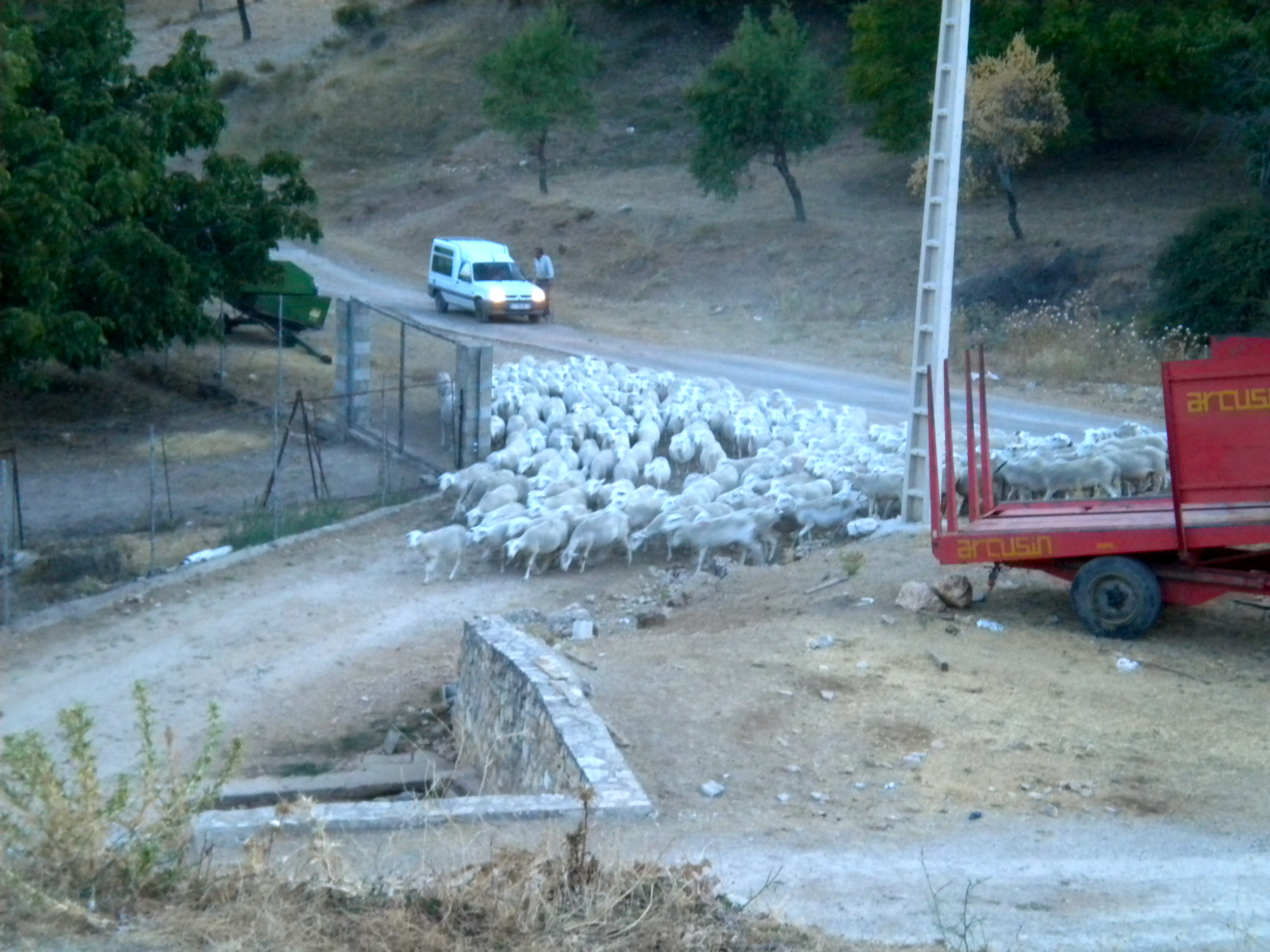
Rounding a bend, the vehicle startled three small mountain goats (likely representatives of Capra pyrenaica, the Spanish Ibex), who bounded down the steep slope into the forest. Every ten minutes the bus stopped at another little hamlet to unload more old women laden with shopping bags, all of them talking continuously. Within an hour, and after a brief spate of negotiation with the bus driver, Rocío and I were dropped off at a local crossing called Cruz de la Revuelta, and her parents drove down in their white four-wheel drive to collect us. I peered eagerly out the window as dusk settled over the fields. We had arrived in Huerta del Manco just as the local shepherds were taking in their flocks for the night, and the car crept past a vast number of the braying creatures, every one in ten bedecked with a large metal bell on a leather collar. A large mixed-breed dog jauntily trotted down the road after them, ears pricked up and tail held high.

DSCN9946 Dinner consisted of a tortilla Española that Rocío’s mother Pepa deftly slid out of a cast iron pan and quartered, plus the typical array of simple yet staggeringly delicious Spanish fare: jamón Serrano, lomo, local bread, and sheep’s cheese. Pepa had also made small ceramic pots of arroz con leche for dessert, a sweetened rice pudding made with sugar and lemon, topped with a dash of cinnamon. While helping to clear the dishes, I realized that the family had an entire hock of jamón Serrano elevated on a stand on one kitchen counter. I was entranced. “What is that called?” I asked Rocio, pointing at the massive slab of meat. “Una jamonera” she told me simply, as if it were an apparatus as mundane as a coffee-maker or toaster.

Dapper ChicoMountain nights provided a welcome contrast to the bustling and oppressive heat of late summer evenings in Jaén. The air was tinged with a slight chill that hinted at the gradual encroach of autumn, and the alpine silence was deep and near total, only occasionally punctuated by the cascading barks of local dogs. I woke the next morning after a death-like slumber, stumbling downstairs to find a massive pot of chocolate steaming on the gas stove. Rocío and I breakfasted on what she facetiously termed “churros de pan”, dipping thin slices of bread into glasses of the heated mixture of milk and melted chocolate. Her uncle joined us for breakfast, eating in a fashion that I came to realize was typical of the inhabitants of these mountain villages, eschewing the use of a fork and relying instead on a small, sharp knife called a navaja as his sole form of cutlery. He deftly carved off of hunks of bread, pieces of sheep’s cheese and bites of salchichón, cupping the food in one hand, with his thumb braced to act as a bulwark against the swift progress of the blade.
La Fuente del Sancho

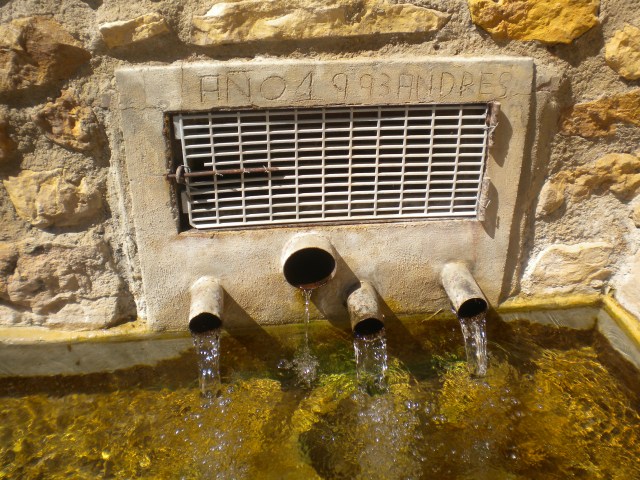
We set off soon after to explore the village and its environs. In sharp contrast to my own far-flung upbringing, all of Rocío’s family history is nestled in one small valley in this mountain chain. Her father grew up in a village called Los Ruices, a stone’s throw to the northeast of Huerta, while her mother hails from the slightly larger town of La Matea, only a few kilometers southwest. Rocío showed me the fountain just beneath her house, explaining that most people in this part of the world still get their water from mountain springs since it tastes better than water from the tap. We visited her parents’ huerto, a large field a short distance from their house, where they grow potatoes, beans and peas, as well as tomatoes and cucumbers in their invernadero, or greenhouse. The northwest corner of the plot is marked by a flourishing pear tree; somewhat unwisely I told Pepa that the one pear that I had pilfered from it was delicious, and almost immediately received several pounds of pears in a large plastic bag to take back to the city with me.

Pera

After our brief and desultory perambulations we returned to the house for lunch, which in this part of the world is traditionally the largest meal of the day. Pepa had outdone herself, roasting chicken and potatoes in a broth of “garlic, lots of onions, and a little olive oil”. The potatoes turned the bright, buttery yellow that signals roasted perfection, and I mused, as I have many times since my arrival in Spain, that they know how to cook potatoes in this country, a feat that has yet to be accomplished in my homeland. The next afternoon Pepa prepared migas, a sort of deconstructed dumpling made by pan-cooking a mixture of flour, water, shredded potato and salt, one that can be topped with everything from roasted pepper to cured meat. Watching me gleefully spear several links of chorizo to adorn my migas, Pepa gestured at them with her hand. “Those were made here,” she said off-handedly. After further questioning it came out that not only does Rocío’s family cure their own jamón Serrano, but they have also always prepared their own spiced sausages. “I bought some from the store once” Pepa told me, by way of explanation. “They were not very good. ”

Almuerzo

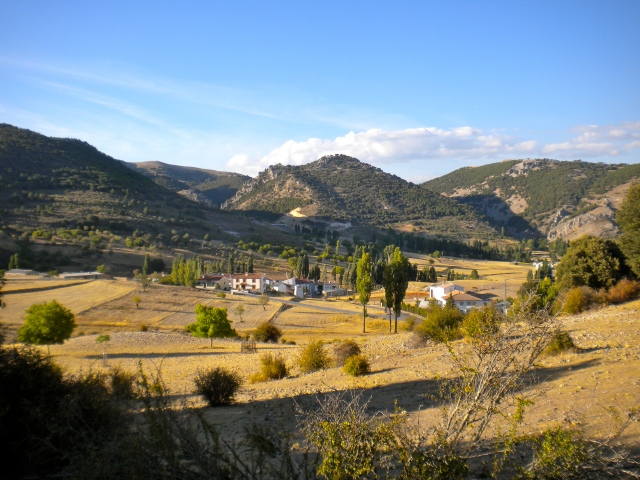
Over the next two days we passed all of our time either sleeping, walking or eating. The local roads wound up and down hillocks, linking chains of tiny mountain villages that sometimes contained as few as four houses. The sun coating the hills and peaks was warm but gentle, the brutal glare of Andalucían high summer having burned off several weeks before. As the afternoon progressed clouds rolled across the valley, momentarily plunging small peaks and valleys into shadow, and wafts of the sweet, viscerally rural scent of dried sheep dung provided a constant perfume. We trekked for several miles to visit a local waterfall and riverbed, both of which were dry after the pronounced aridity of the summer. Rocío joked that she was ushering me around a ghostly landscape, deeming the local site “la cascada fantasma”.
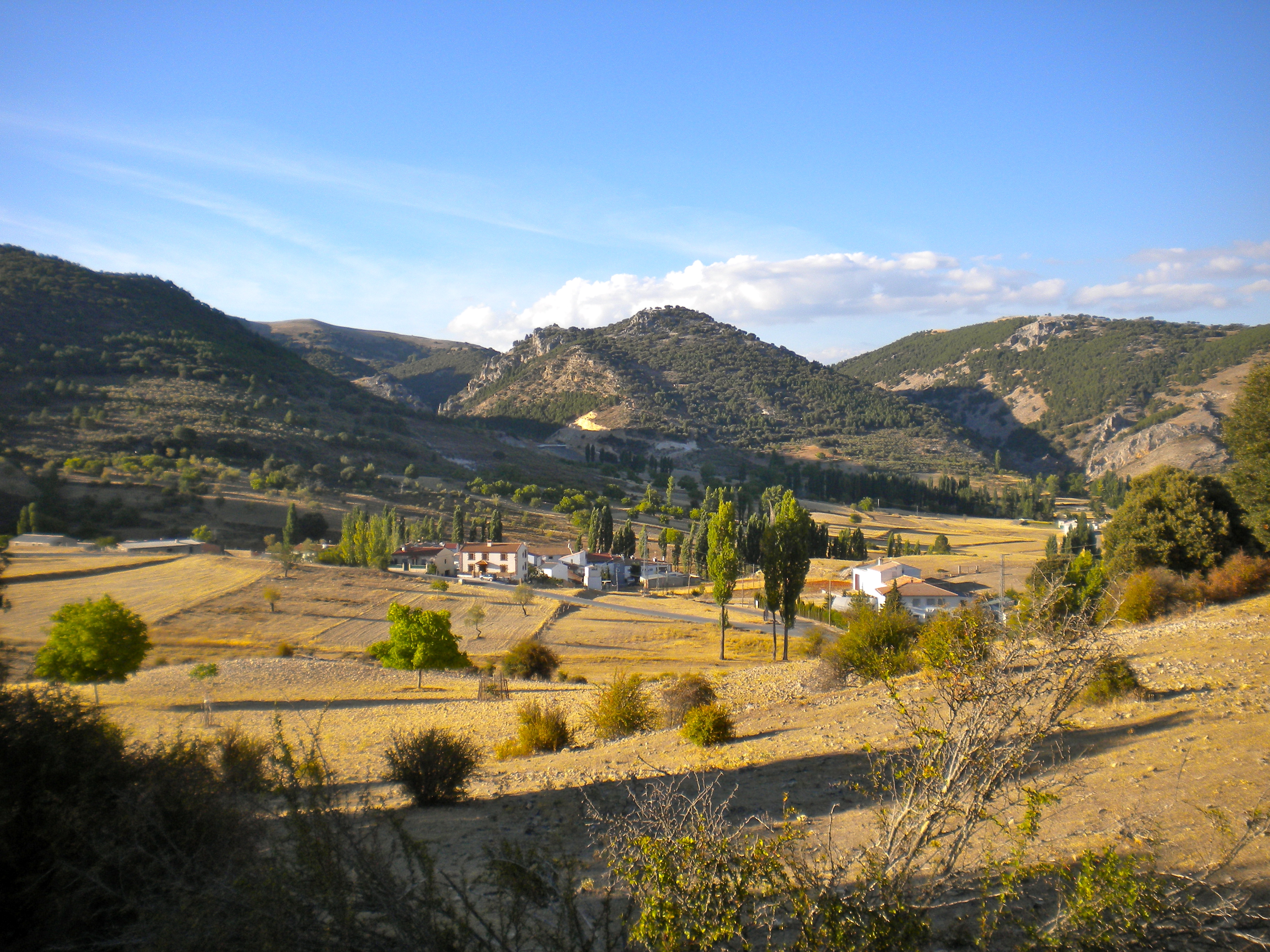
View of the valley from Los Teatinos

While exploring the caves around the waterfall I heard the hushed rustling of furtive animal movement in the tall grass, and glanced up to see a fox tail flicker across the opposing slope. This was still a region where animals outnumbered people – in addition to extensive gardens, the local populace tended herds of goats, cattle, and horses, most of which were guarded with by quiet professionalism by large mixed-breed dogs. Traversing the valley’s tranquil hills, ambling through quiet streets where old men sipped coffee and women collected laundry, I marveled at the remarkable preservation of the traditional country way of life in this part of Spain. It was as if the world had taken a deep breath in 1952 and forgotten to ever exhale; time, if not frozen, certainly seemed to proceed at a more languid pace in these mountains, effecting change as slowly as honey being poured over the hills. In America, these small rural communities are rapidly disappearing, a socioeconomic shift wrought by the government’s increasing support for large-scale commercial agriculture. On one of our strolls I asked Rocío if she ever planned to return to her town, a part of me fearing the inevitable negative response that characterizes so many young Americans’ reactions to their home soil. “Of course,” she assured me in Spanish “Es mi tierra” – “It’s my earth”.

Migas lunch

My last morning in the village I trooped down the cement path to La Fuente del Sancho, to fill the dark blue plastic water jug used to replenish the household drinking supply. The squat yellow-capped bottle has a length of twine tied around its neck to make it easier to handle, and you must forcefully plunge the buoyant, empty base into the fountain pool to lower the vessel beneath the spigots. I was filling the last third of the jug when I heard a sudden rush of noise behind me. I felt a momentary panic and looked up, expecting to find a pack of feral dogs or irate locals defending their turf, until I realized it was just one of the town’s ubiquitous flocks of sheep. Bleating and rolling their eyes back, they crowded behind me in fearful surprise, slamming into one another in their haste to avoid the strange alien creature pirating their water supply.
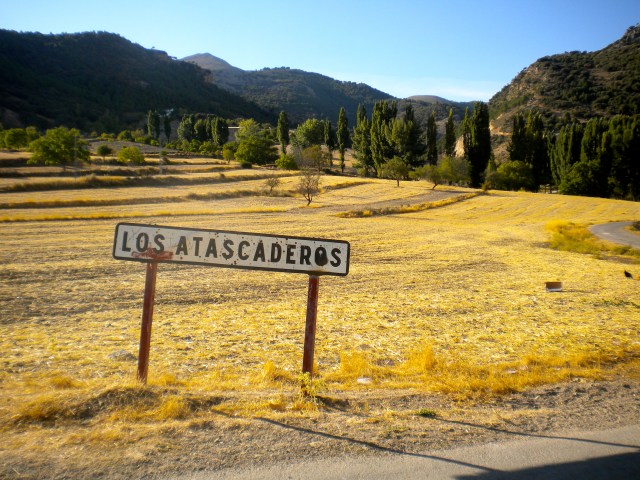
Local signage Forearms dripping wet, I muscled the bottle out of the water and backed off as I screwed the cap on tightly, granting the rightful owners of the water supply access to their territory. As I headed back to the house, I realized that not even the sheep in this region made me feel unwelcome. I will always remember ambling through impressive peaks in the tranquil afternoon haze of late summer, fondly recollect the amazing hand-made delicacies unearthed from local larders and hear echoes of the jangle of bells announcing ovine movement several kilometers distant. However, what I know I will keep with me longer than any fleeting sensory memories of my trip is a deep and lasting appreciation for the incredible hospitality that I was shown by everyone I met on my visit to these timeless mountains.
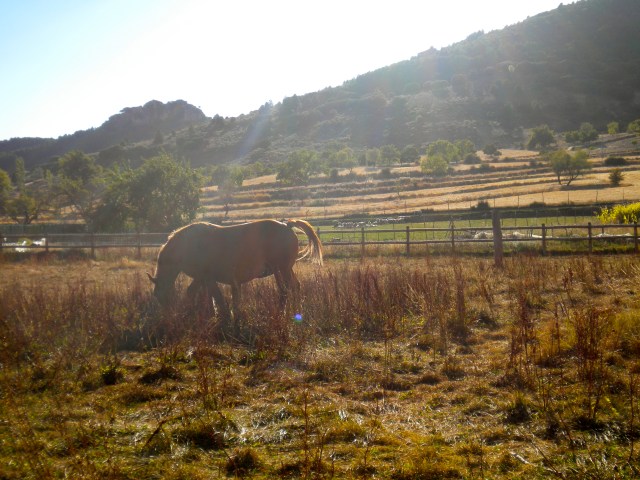
Animal life in Los Atascaderos


Posted in Travel, Travel Essay | Tagged , , , , , , | 2 Comments

Pop Culture Osteology: Once Upon a Time #3

If you read this blog for the osteology and are largely unaware of the plot of the hit ABC show Once Upon a Time, allow me to concisely catch you up to speed:

A 28-year old New York bail bondswoman named Emma Swan opens her door one night to find her eleven year old son Henry, who she had given up for adoption more than a decade ago, standing on her mat. Henry explains that she must return with him to the town of Storybrooke, Maine, whose residents are all fairy-tale characters who were transplanted to the mundane American Northeast some twenty-eight years ago. These ‘characters’ have been frozen in time ever since, as the result of a terrible curse cast by the evil queen, Regina, who is also Henry’s adoptive mother. Over the course of the first two seasons, we discover that because of the chronological suspension wrought by the curse, Emma’s parents from the Enchanted Forest are actually her own age – in their late twenties. Also, Henry’s grandmother, Snow White, is his adoptive mother Regina’s step-daughter, and Rumplestiltskin, Henry’s grandfather on the other side, had a brief affair with his adoptive mother’s mother Cora (Henry’s great-grandmother), several decades ago, and so for all we know Henry’s  biological father and his adoptive mother may be step-siblings.*

Nope, I can’t do this concisely. I give up. All you need to know is that the Once genealogy is basically a kinship diagram designed by M.C. Escher.

In addition to stretching the boundaries of the definition of ‘blood relatives’, the Once screenwriters and prop masters also like to dabble in osteology every now and again. Though I watch this show largely to relieve dissertation data-collection related anxiety, I find myself hard-pressed to ignore the stalwart efforts of the Once team to incorporate human and animal remains into their sets and plot lines. While the show’s dialogue is often ludicrous:

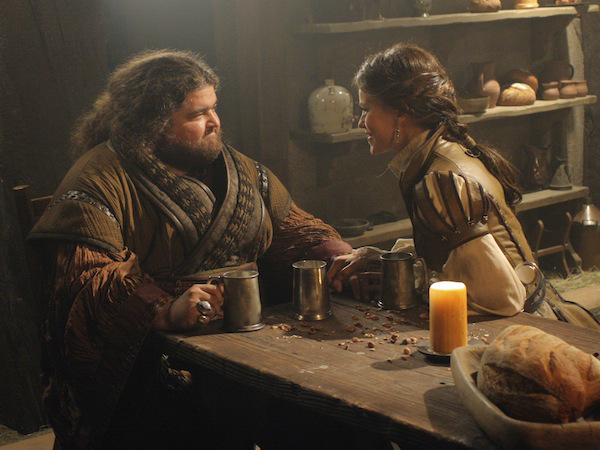
No one steals from a dwarf.“No one steals from a dwarf!”

Lessons on self-acceptance from Ruby“You’re Frankenstein, and I’m the werewolf. I…ate…my boyfriend.”

and its convoluted plots always seem to rely heavily on theoretical principles pilfered from quantum mechanics (Can you really be someone’s step-mother and the adoptive parent of their grandchild simultaneously?), I have developed an inordinate fondness for this show.

Which brings me to the next episode of “Pop Culture Osteology”, as Season 2, Episode 13 introduces not only evidence of birds the size of pterosaurs, but also a heretofore undocumented pathological condition of human skeletal remains.

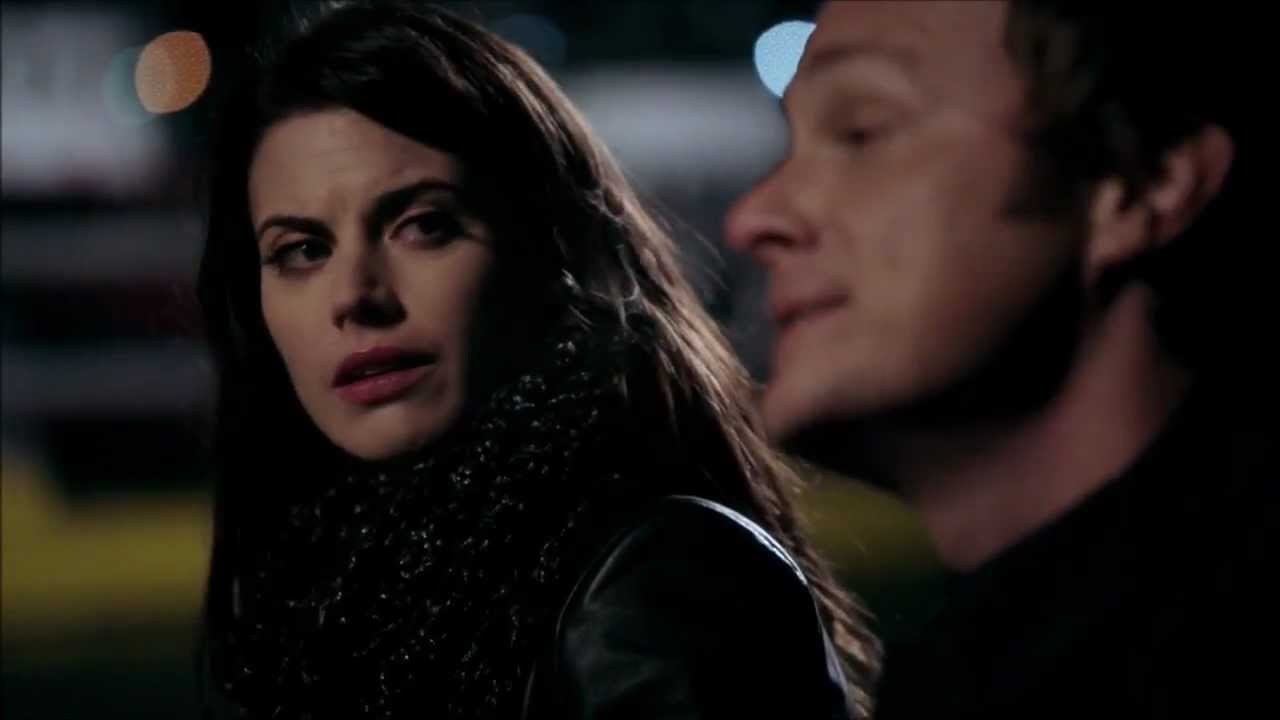
Pursuant to knocking out the giant (see previous post for backstory), Hook and Emma steal into his castle to search for the magical compass that will guide them back to Storybrooke. While combing through the castle’s vast heaps of treasure, they stumble upon a skeleton. But not just any skeleton – as you can see by the blade clasped in their hand, this individual was known as “Jack the Giant Killer”.

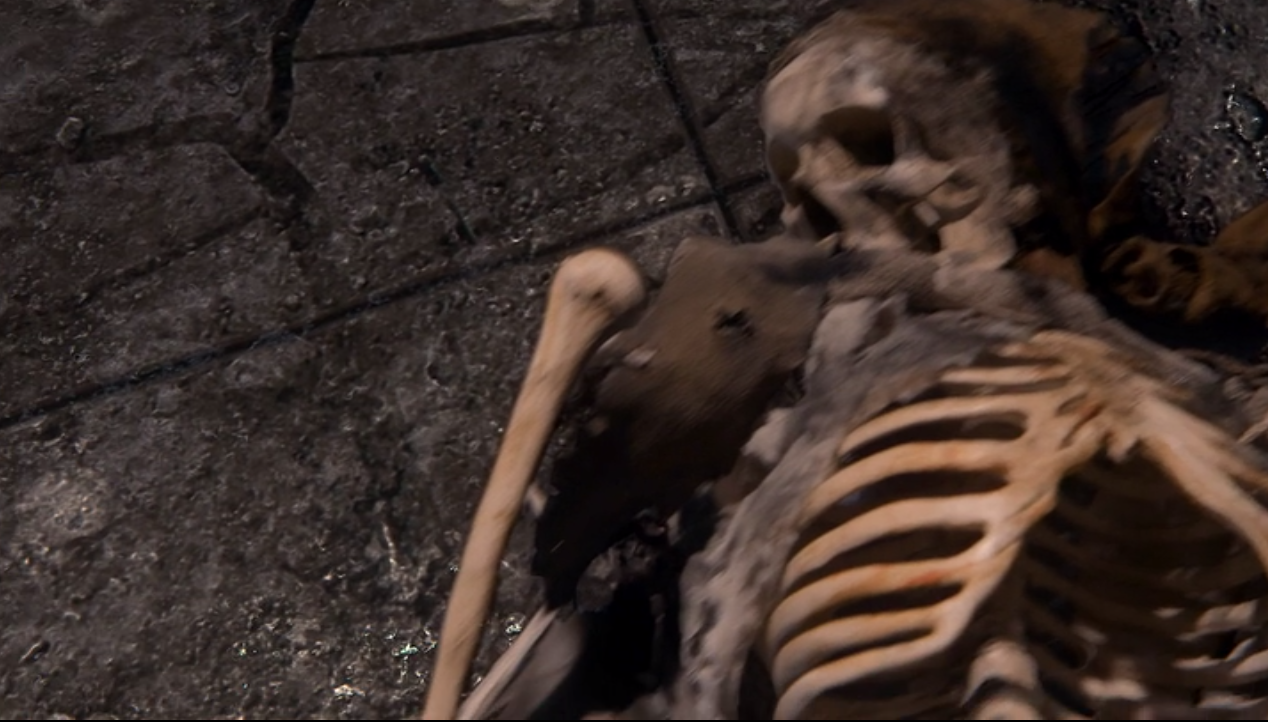
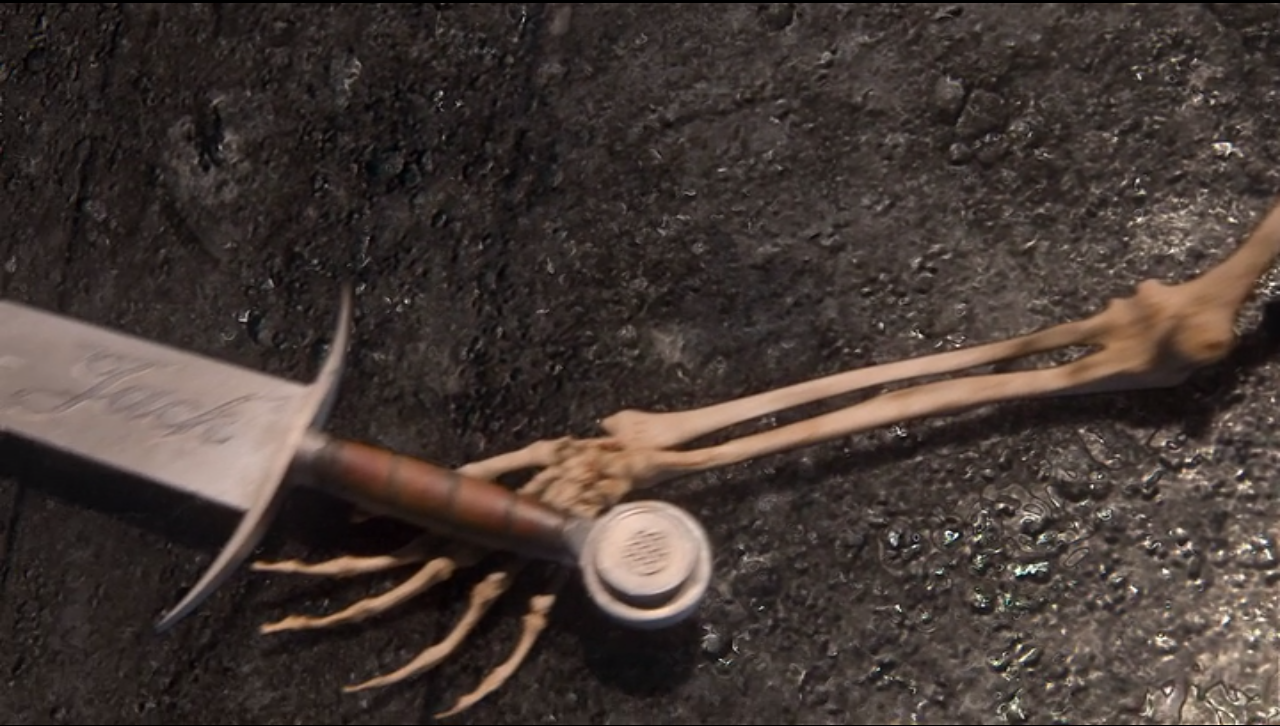
Later in the season we learn that “Jack” is actually short for Jacquelyn, which does not explain the spelling of the name inscribed on the blade below, nor the right-angled mandible in the screenshot above, since 90˚ angles are more characteristic of male mandibles, while females tend to have more obtuse gonial angles. However, sex estimation using the skull is a somewhat qualitative process, a methodological pitfall that the Once screenwriters are correct to call attention to.

That’s not what bothers me about this skeleton, however. First off, if you examine the screenshot above, this individual shows costal cartilage that appears fully calcified, despite the fact that ossification of the costal cartilage is uncommon in individuals of less than 30 years of age, suggesting the involvment of “infections, mineral metabolism, thyroid disease, chronic renal failure” or genetic factors – poor Jacqueline!

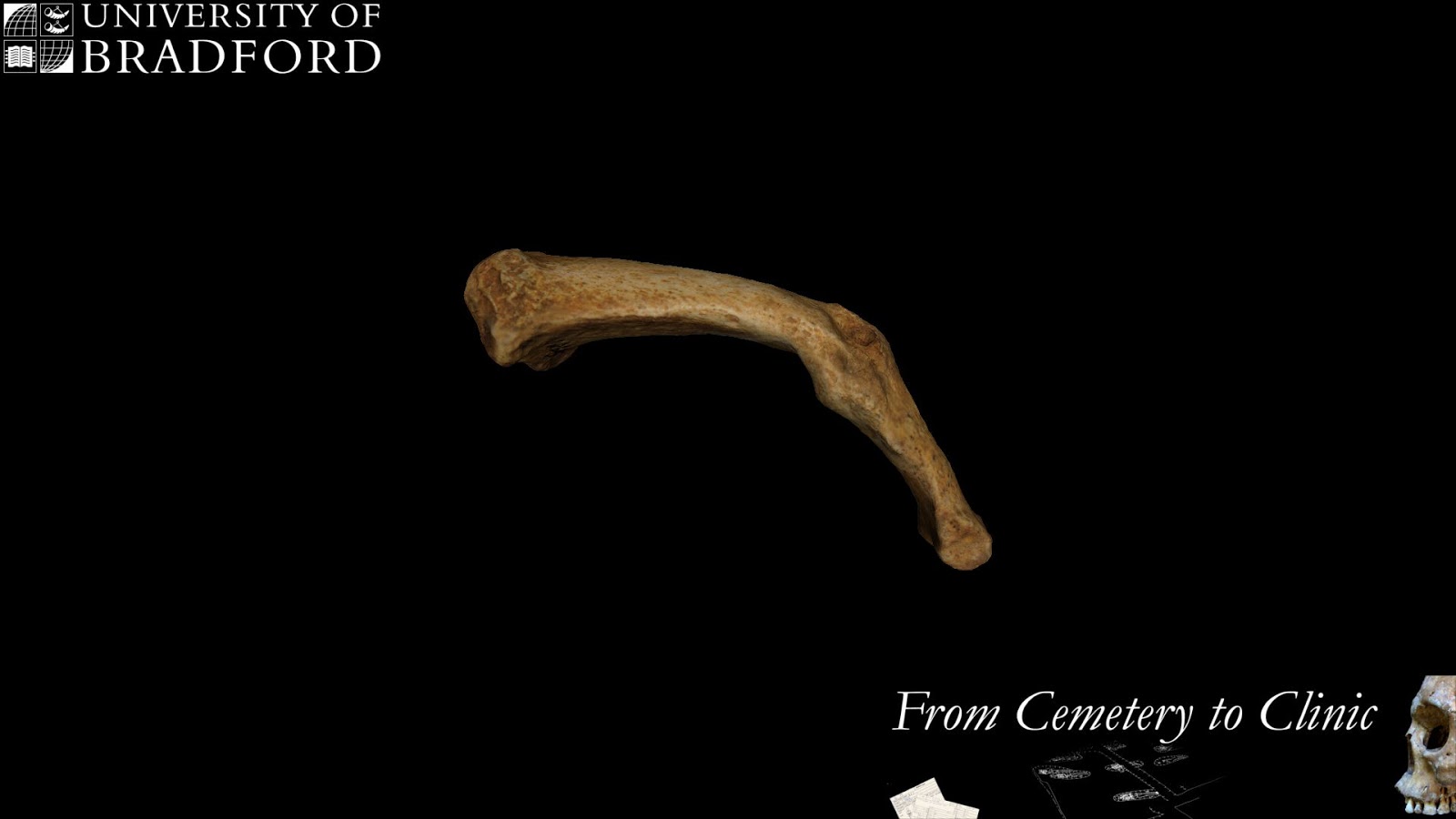
I also find the state of Jack’s right elbow particularly troubling:OuchAs you can see the proximal ulna and radius are fused to the distal humerus. It would appear that Jack suffered from some terrible form of osseous ankylosis. Ankylosis is a condition that occurs when the inflammation at a joint surface is so severe that the bones involved fuse together, prohibiting movement, as in the case of the manual phalanges shown below:

Ankylosis of the manual phalanges

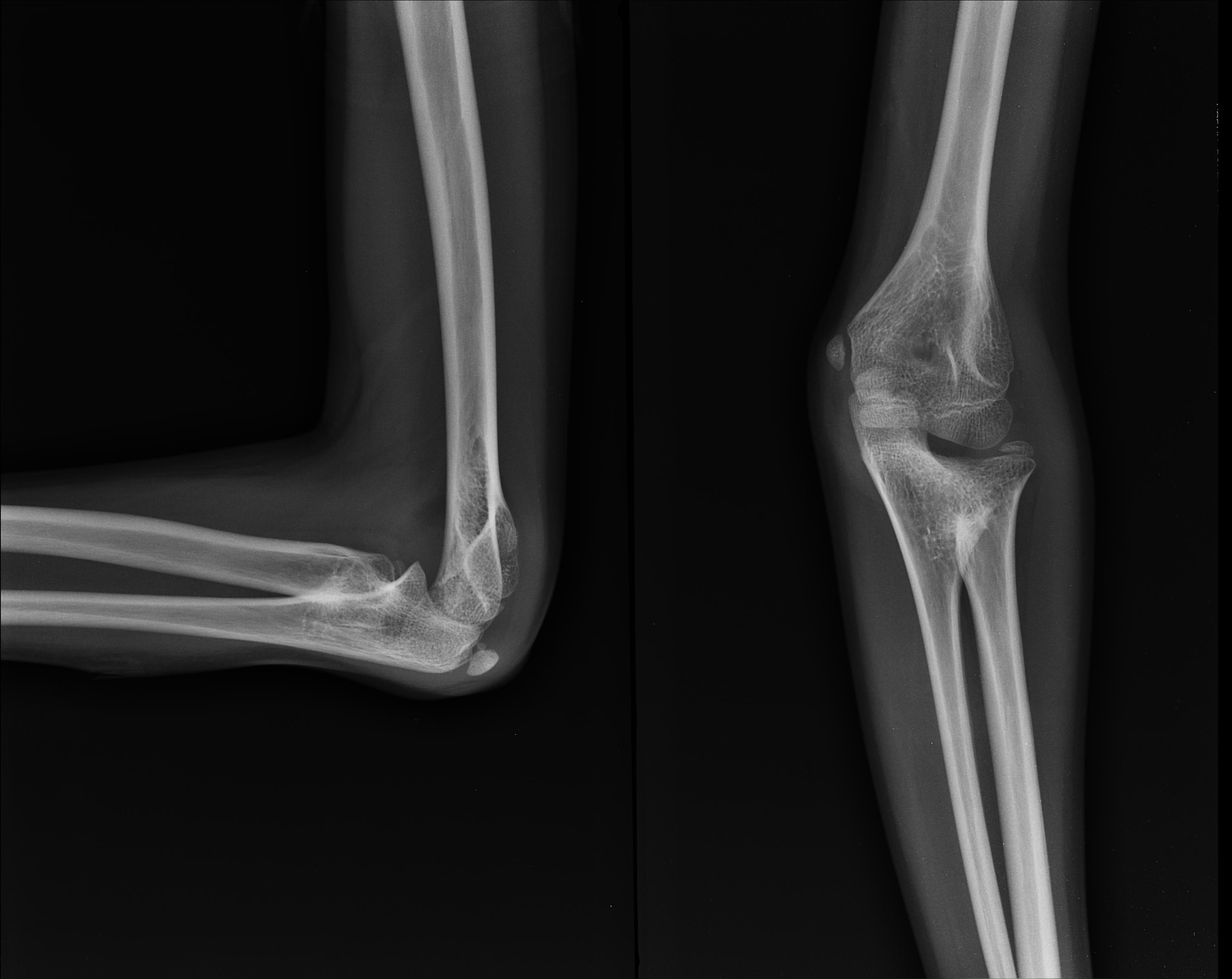
While this could be a case of radioulnar synostosis (a fanciful term for fusion of the heads of the forearm bones near the elbow joint), I believe it would be rare for the distal humerus to become involved as well – typically this form of synostosis seems to affect only the proximal radius and ulna, as in the x-ray below. However, perhaps because Jacqueline spent so much of her time wielding a sword and slaying giants she developed a pronounced case of atlatl elbow, one so severe that it led to synostosis. As a caveat, I’m not a paleopathologist, so I don’t know if it is possible for the etiology of that particular ailment to follow such a path (paleopathologists, feel free to chime in here…).

Radioulnar synostosis

What is even more astounding is that despite these numerous and severe skeletal pathologies, Jacqueline demonstrated no apparent discomfort or abnormal patterns of movement during her life. Here, you can see here happily swilling beer with a pint-sized giant only a few hours before her death, with her elbows fully flexed:

While just a few hours later, we see her at the prince’s side, elbows extended. No evidence of discomfort whatsoever.
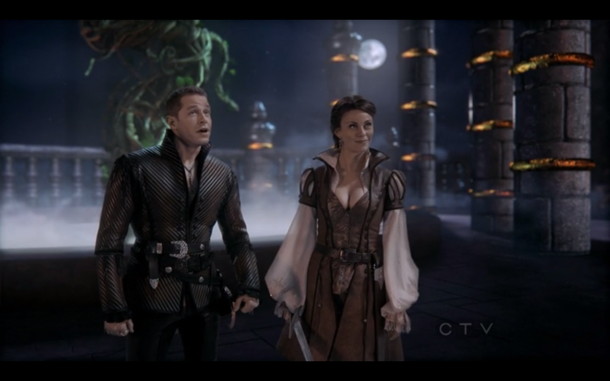
Perhaps the magical atmosphere of the Enchanted Forest is able to heal not only heartache, but also severe cases of of radioulnar synostosis. Or wait, maybe I’m thinking of “True Love’s Kiss”, a panacea that gets used to cure everything from sleeping curses to impending oblivion.

Whatever the reason, they should definitely write this up as a case-study for the International Journal of Paleopathology.

* I also find it perplexing that Lana Parilla plays the stepmother of Ginnifer Goodwin’s character, since during flashbacks it is implied that Regina is at least 15 years older than Snow White, when in actuality the actresses are only a year apart in age.

Image Credits:
Photo of pensive Ruby and Dr. Whale found here, photo of an irate Grumpy found here. First photo of Jacqueline the giant killer found here,  second photo taken from here. Photo of ankylosis of hand phalanges pilfered from Powered by Osteons, here, though for some reason I have a sense that the photo was probably originally derived from the University of Bradford. Radioulnar synostosis x-ray taken from radiopaedia.org, here.

Posted in Osteology, Pop Osteology | Tagged , , , , , | 3 Comments

Pop Culture Osteology: Once Upon a Time #2

Intrepid. Swashbuckling. Fearless. All adjectives that describe my tenacious approach to dissertation data collection. Oh wait, no, I’m wrong again. These are all adjectives that describe the rapscallion Captain Hook and imperturbable Emma Swan on ABC’s fairy-tale soap opera Once Upon a Time.

Why am I so focused on this show, you ask? I have approximately 1,675 reasons to need a turn-off-my brain fantasy outlet, all of them loose human teeth. With a month and a half remaining in my final season of dissertation data collection, I’m rapidly becoming an automaton who is only capable of dry-screening bags of dirt and human bone, entering teeth, and eating sandwiches. Watching Once reminds me that there are other things in life besides osteological to-do lists, and gives my beleaguered brain cells an hour a day to recuperate by languishing in a warm cocoon of televised intrigue.

I must say, however, that this past week the show has not done a very good job keeping my mind off of bones.

TO WIT: Here we are in Season 2, Episode 6, where the rakishly handsome Hook and dauntless Ms. Swan are invading a giant’s castle in order to steal a magic compass that will allow them to journey to small-town Maine, an apparently irresistible destination for all fairy tale characters. Emma and Hook decide that their best shot at disarming the giant is to lull him into a deep, unnatural slumber. However, in order to dose him with a magic sleeping potion, they must first attract his attention. Hook, being your typical high-T costly-signaller, decides to alert him to their presence by banging on a a nearby drum. Logically, he grabs the nearest large object at hand to use as a mallet and races to the drum.

Percussion time

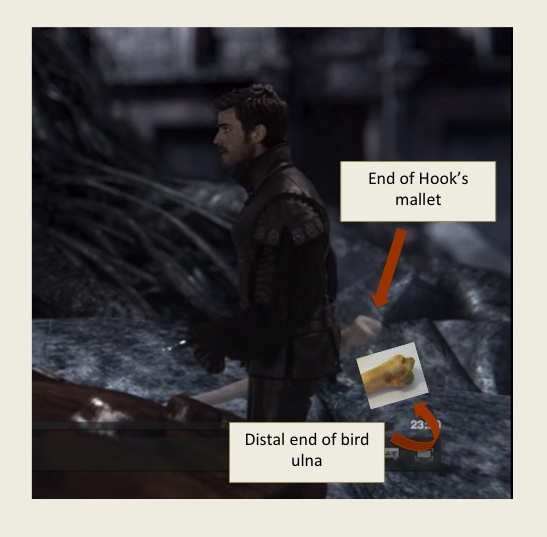
But wait, you ask, what is that he is carrying? Some kind of bone? Clearly it’s too big to be human. Ostensibly it could belong to a giant, since all of the giants at the castle except for the antagonist were slaughtered in a recent war with the humans. Let’s take a closer look, shall we?

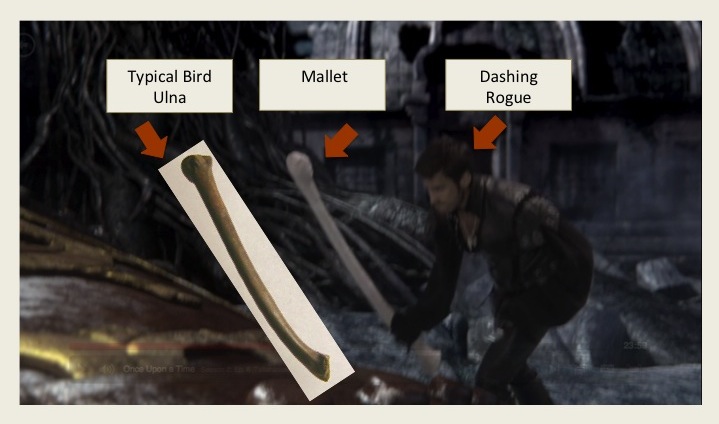
Hook and his ulnaHmmm…definitely not a bone belonging to anything anthropoid. It’s too long and narrow, and exhibits such attenuated proximal and distal ends. It seems oddly familiar, however.
Perhaps because it is a BIRD ULNA.

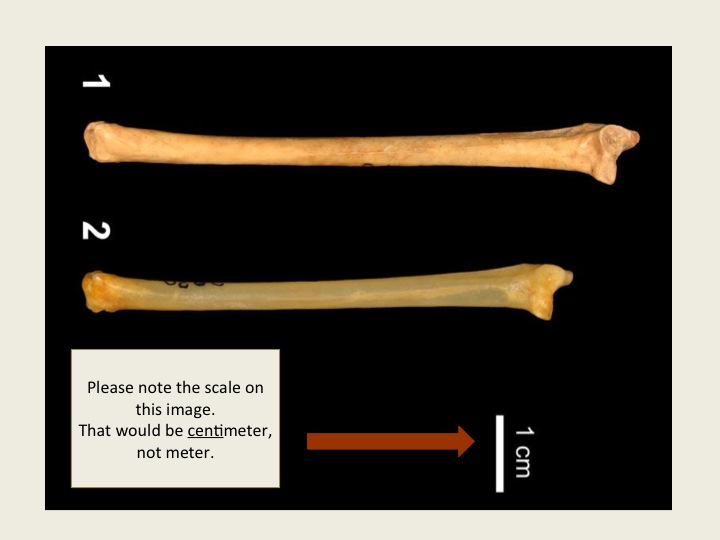
Here’s what your typical avifaunal ulna looks like:

Typical Avifaunal Ulna

This bone bears a striking resemblance to what Hook is using to drum up some interest from the giant. In fact, it’s basically identical once you remove the pesky issue of scale.

Instructive diagram
Here, you can even see how similar the end of the mallet is to a typical distal bird ulna:

 I rest my case.

Now, if we conservatively estimate that this ulna is about half Hook’s height (actor Colin O’Donoghue is 1.80 meters tall, according to the ever-omniscient Google), that would be in the range of .9 meters, or 900mm long. For comparison, the ulnar length of the wandering albatross, a creature with the largest recorded wingspan of any bird, is around 400mm. When investigating a fossil albatross in 2007, Dyke and his colleagues collected a sample of ulnar lengths for Diomedea exulans, the aforementioned Yao Ming of the bird world. I used their data on the relationship between ulnar length and total wing length to calculate the equation for that line, as follows (note that the axis does not start at 0-0):

Ulnar Length vs Wing Length, the Wandering Albatross

If that equation is used with an ulnar length of 900mm, it predicts a bird with a wing length of 1657mm. To give you an idea of that scale, here’s how that wing would compare to our formerly impressive wandering albatross sample:

Wing Length - Wandering Albatross vs. Once Bird

Now, the average wing length for their sample is around .980 meters, and the Once ulna beats that out by a factor of 1.6. Wikipedia (with citations) lists the average wingspan of the wandering albatross as 3 meters. If we multiply that by our factor of 1.6, this suggests that the ulna Hook is being so cavalier with belongs to a bird with a wingspan in the neighborhood of 4.8 meters, or 15.7 feet. For an idea of how this scales relative to your average human, see the blue representative of the Quetzalcoatlus sp. in the figure below.

That means there is some sort of bird that is as large as a pterosaur making its home in the vicinity of  the giant’s castle. My question is simple: WHY AREN’T HOOK AND EMMA MORE CONCERNED ABOUT THIS? They spend their entire episode swanning around trying to capture the attention of a clearly distracted giant when all evidence suggests that there are BIRDS THE SIZE OF PTEROSAURS in their immediate environment.

idno
Once, you are so full of mysteries. And that’s not the only curious osteological plot point from that particular episode…Tune in for another Once-inspired instalment of Pop Culture Osteology – “Jack’s Curious Case of Osteoarthritis” – next week.

References
ResearchBlogging.orgDyke, G.J., R.L.Nudds and C.A.Walker (2007). The Pliocene Phoebastria (‘Diomedea’) anglica: Lydekker’s English fossil albatross Ibis (149), 626-631


Image Credits: First bird ulna image taken from palaeo-electronia, here. Second bird ulna image (superimposed over Hook’s avifaunal mallet) found at the Fossil Forum, here. Third bird ulna image found at a washington.edu course website, here. Image of human to-scale with various Quetzalcoatlus species found here.  Exasperated Jennifer Morrison gif found here. All other images are screenshots taken from Once Upon a Time, and are the property of ABC, etc., etc.,

Posted in Fauna, Osteology, Pop Osteology | Tagged , , , , , , , , | 7 Comments

Pop Culture Osteology: Once Upon a Time

Once_Header

Last night was Friday, so being the diligent graduate student that I am, I spent all evening organizing my spreadsheets, editing a chapter that is soon due and working on conference abstracts. Oh wait, no, no I didn’t, I spent it eating cookies and watching trashy American TV. I was immersed in an episode of ABC’s Once Upon a Time, a show noteworthy for its gritty depiction of life in small-town Maine, linear plot, and subtle script (sample dialogue: “I’m a dwarf, Nova. I belong in the mines. You belong with the other fairies, and that’s never going to change”).

However, mid-way through an episode, I was forced to hit pause. Prince Charming (Yes, I know) and Lancelot (Yup, that Lancelot) were journeying to Lake Nostos, a body of water that had formerly been home to a deadly siren, to try and find a cure for a wound inflicted upon Charming’s mother, who was being tended to by Snow White (See what I mean about linear plots?). Charming had slain the seductive siren in a previous battle, and so they arrived at the lake shore to find it empty and barren, drained of all water and hence of all magical healing properties. Charming blames himself, chalking the newfound aridity up to the death of the succubus. However, while traversing the lake bed they come across a skeleton that likely belonged to the siren (as is implied by the crystal crown that Charming hoists off of the remains), and I realized why this woman had had it out for all visitors in the past.

Remains of the Siren...

Wouldn’t YOU be a little tetchy if you had three fibulae?

Labelled Siren Remains

I have helpfully labelled the elements present in this poor woman’s skeleton here. In addition to the two ribs visible in the first photo, her postcranial remains appear to consist solely of a humerus and three fibulae. While the lowest long bone visible at first seems like it could be the distal half of a radius, you can tell it’s a fibula in the photo below based on the extremely long and narrow shaft that demonstrates the characteristic torquing angularity of this particular leg bone.

Fibulae and the crown

No wonder Charming looks so confused.

The intrepid Charming
Image Credits: Once header photo was taken from Comic Con Geek, here. All other images are screenshots that are the property of ABC,etc, etc.

Posted in Osteology, Pop Osteology | Tagged , , | 7 Comments

Barcelona

View from Parc de Montjuïc

In early August the city is a teeming stew of people. Coastline and latitude make for a heady mix of sea air and heavy humidity, and everyone is covered in a constant sheen of  sweat. Attempting to navigate the major thoroughfares in the city center, you metamorphose into a sticky, bewildered pinball, careening into waddling tourists, aggressively welcoming maître d’s, and irritable locals. The metro is the worst: the trains are air-conditioned, but the stations, swaddled under tons of dirt and radiant city warmth, are fetid cocoons of heat. Waiting for a train feels like sitting in a pre-heated oven. Locals and tourists alike are covered in a moist film of sweat and body odor, curls of hair plastered onto their foreheads and glued to the back of their necks.

Of course I had waited to read the city guides until after arriving, figuring I would hit the ground running and sort out my itinerary as I went. I started by browsing online, looking for some expat advice: “The worst time to be here? August. All the locals empty the city and are replaced by hundreds of thousands of sweaty Italians, French, Germans, Brits and Americans wondering where all the Catalans went.” Unfortunately, early August was the only time I had free, and the idea of cutting out of Jaén when the temperature reached its late-summer zenith was appealing. “I’ll go north!” I thought excitedly, dreaming of strong sea breezes, a hint of Catalan chill to the night air, and the edgy art and culinary scene for which Barcelona is justly famous.

AVE view

As soon as I boarded the train I realized that northern Spain was going to be a very different experience than the familiar, slow-paced Andalucian way of life. The northern high-speed rail has more in common with a 1950s airplane journey than it does with Renfe’s slower and more spacious Media-Distancia trains of the south. On these sleeker AVE models, slate gray seats are packed with people, all facing uniformly forward. Neckerchiefed stewardesses offer headphones to watch the American movies playing on the screens overhead, while vested attendants wheel sandwich carts through the aisles. While it took less than three hours to reach our destination, some of the modifications were more odious than others – the bathroom toilet bowls were filled with bright blue liquid that emitted an ineffably bizarre scent, the strong sweet smell of bananas not quite masking the unpleasant stench of sewage lurking underneath it.

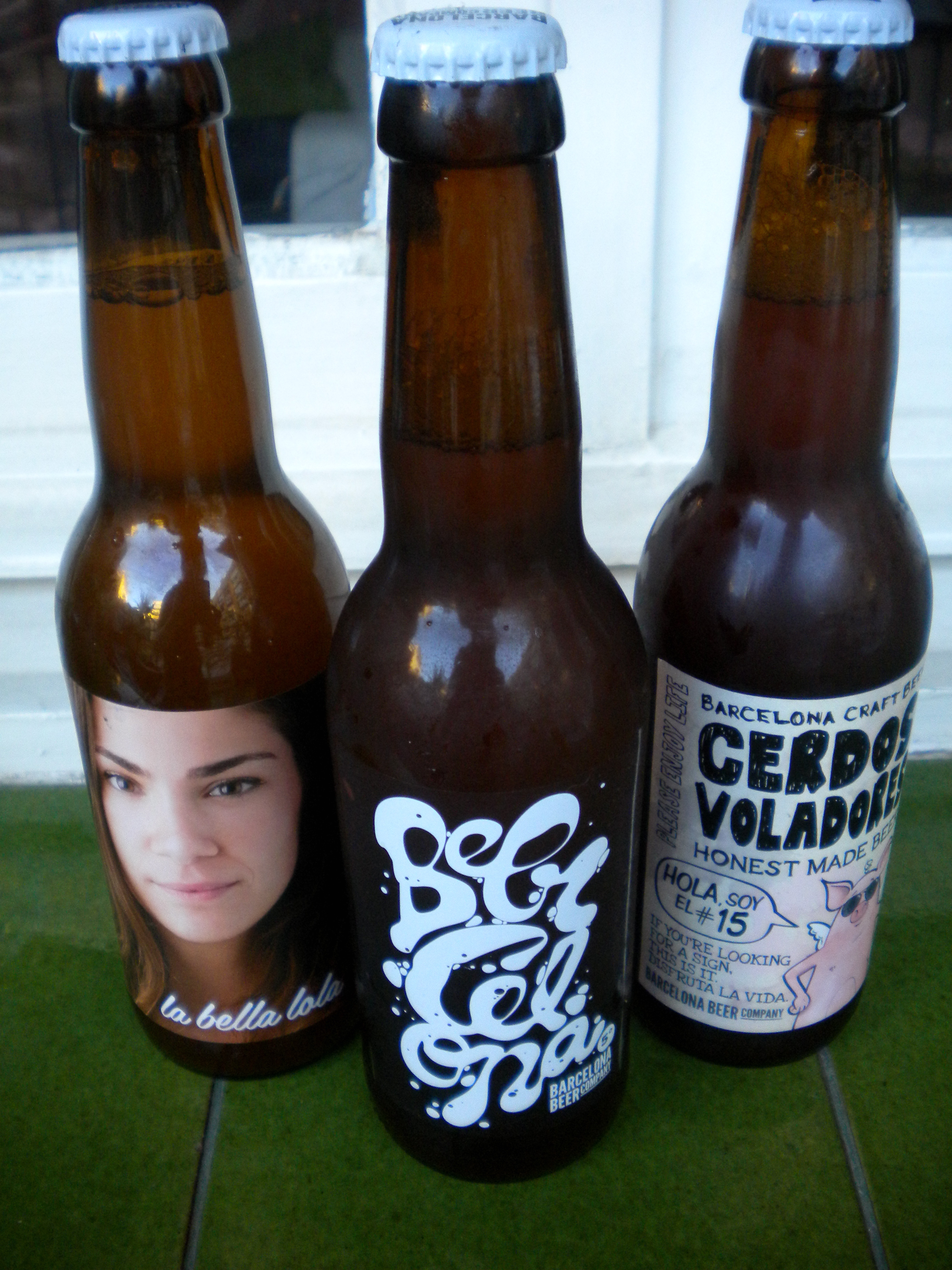
Barcelona brew

I disembarked at the Sants Metro station and was immediately immersed in a brightly colored, multi-lingual crowd. The volume of tourists was unlike anything I’ve experienced anywhere else in Spain. Despite its magnificent cathedral and 12th century Islamic fortress, Jaén is far enough off the beaten path to deter most foreign visitors. Madrid, the other only Spanish city I’ve spent much time in, has its tourist-ridden swathes, particularly within a two-kilometer radius around Plaza del Sol, but it’s easy to strike out and dodge the crowds. Even Andalucian epicenters like Granada or Cordoba offer shaded back streets and secluded bars where you can quietly drink a restorative beer, munch on some morcilla, and get away from it all. Barcelona is a different beast. Having unwittingly arrived at the start of the high season, the city felt under attack; inundated, swamped, and overrun with tourists.

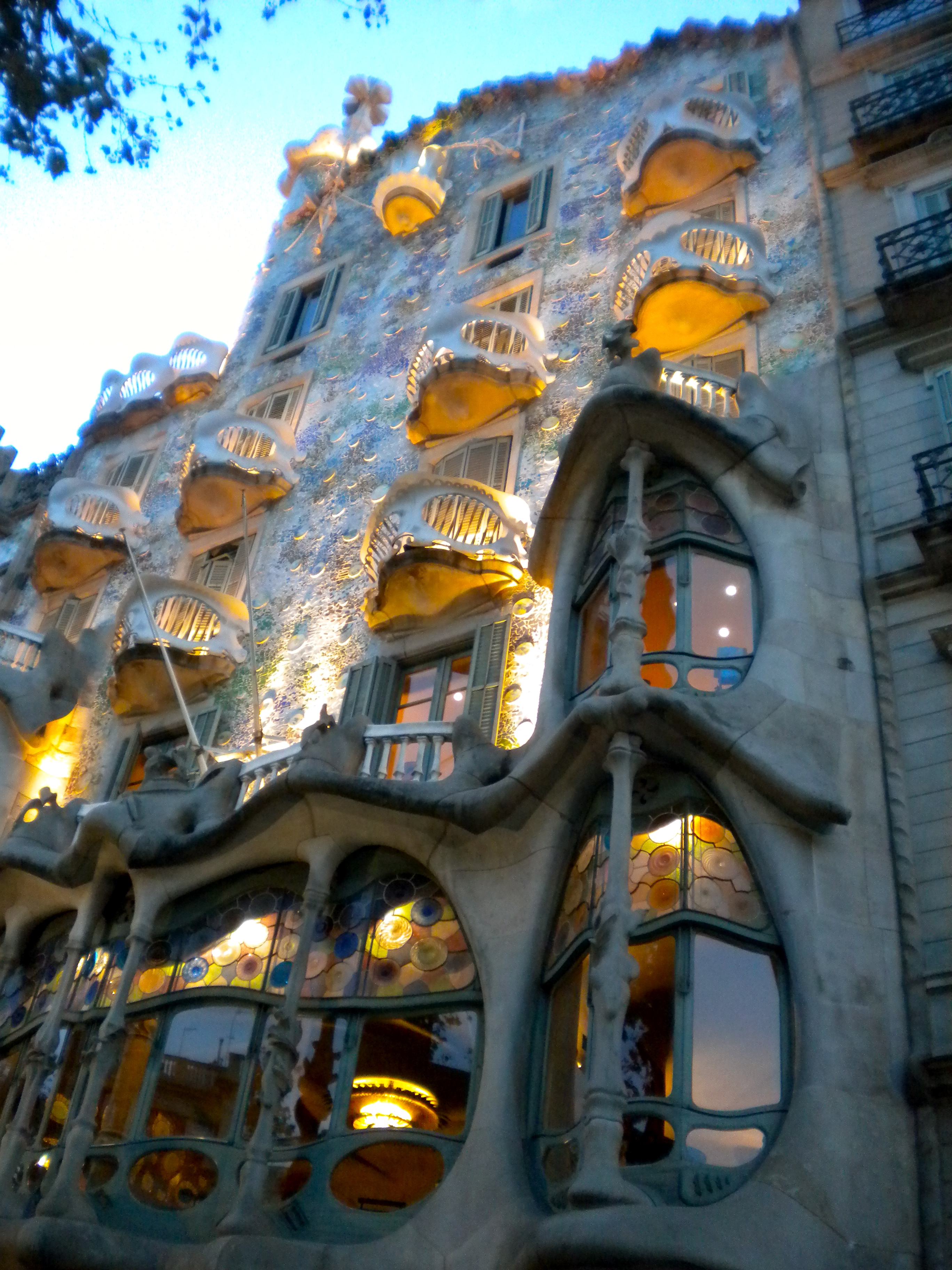
Casa Batillo


Feeling the need to see some of Gaudi’s acclaimed architecture, I struck out for the Sagrada Familia as soon as I got in, and found that every majestic landmark in Barcelona is encircled by a rank, gaudy hub of commercialism. Each cathedral, museum, and monument is fettered by a battalion of matching baseball caps and flashing cameras, hemmed in by aggressively multilingual vendors hawking everything from churros to flamenco to sangria. This experience characterized most of the first two days I spent traversing the streets of Barcelona.

Park Güell

Despite the sheer, stupefying volume of tourists, the monuments were impressive. The Sagrada Familia looks like it was designed by Cthulu during a particularly ambitious bout of universe upheaval. The monstrously brilliant cathedral looms incongruously in the midst of bustling restaurants and leafy, Parisian-style boulevards, appearing to have been just dredged up from some inky underwater abyss. I also paid a dutiful visit to Park Güell, the famous Gaudi-designed suburban community on Barcelona’s northwestern outskirts. However, a niggling ambivalence permeated my experience of the park’s bejeweled lizards and tortuous walkways. It’s difficult to appreciate something as innovative and playful as Gaudi’s approach to architecture when its unique character is plastered on every magnet and coffee mug, coated with an oily gloss of commercialism, and rammed down your throat. Craning my neck to gaze at up at the mosaic roof of the Seussian guard house, ambling along the earthen columns of the Pòrtic de la Bugadera, and peering over the Plaça de la Natura to soak in an unparalleled view of Barcelona, I felt somewhat cheated. The park was an anomaly. Deliberately, painstakingly designed to be lived in, the community now served as an abandoned stage-set, an empty wooden background pierced only by the constant whir and click of expensive cameras.

La Boqueria

The Barri Gotico, Barcelona’s famous old quarter, was similarly unsettling. It was possible to get lost amongst its towering dark allies for minutes at a time, emerging every now and again to witness the erupting ramparts of gothic churches, but every few streets were punctuated with reminders that this too was just for show. English signs for youth hostels decorated doorstops, a slue of bars proudly advertised the atrocious Dutch beer they served on tap, and fluorescent souvenir shops cropped up like weeds. After perambulating all the way down to the delightfully tacky Eurotrash beach-front, I threw in the towel. Stopping in a hostel bar staffed by multilingual American-Spaniards who switched accents and languages as easily as blinking, I gave up on my storied Barcelona dreams, and ordered a Brooklyn Brown Ale, the first dark beer I’d had in two months. Heavy with alcohol, sweeter and more flavorful than any mass-marketed Spanish lager, it was delicious. This was the point at which my experience of Barcelona began to change.

Llaminets from Mercado Santa Caterina

Embarrassingly, I’d forgotten the cardinal rule of European travel, one that apparently has yet to be drilled into my brain after years on the ground in tourist hot spots like Prague and Paris. When you visit somewhere new, don’t do what you think you should do. Abandon the Herculean labor of ticking off every box on a Frommer’s checklist, spending tedious hours in overpriced museums and languishing in the interminable lines that snake tortuously around local landmarks. The necessary first step to fulfilling travel is shrugging off the nagging feeling that you have to do or see specific things in order to make your journey worthwhile. I’ve felt this twinge of traveler’s guilt frequently in the past, a little stab of rueful remorse that pricks me whenever I bypass an archaeology museum or spend a day wandering the streets with no set schedule. However, over time I’ve found that the more I ignore that vexing, misplaced sense of responsibility, the more rewarding my travel tends to be.

Marzipan at La Boqueria

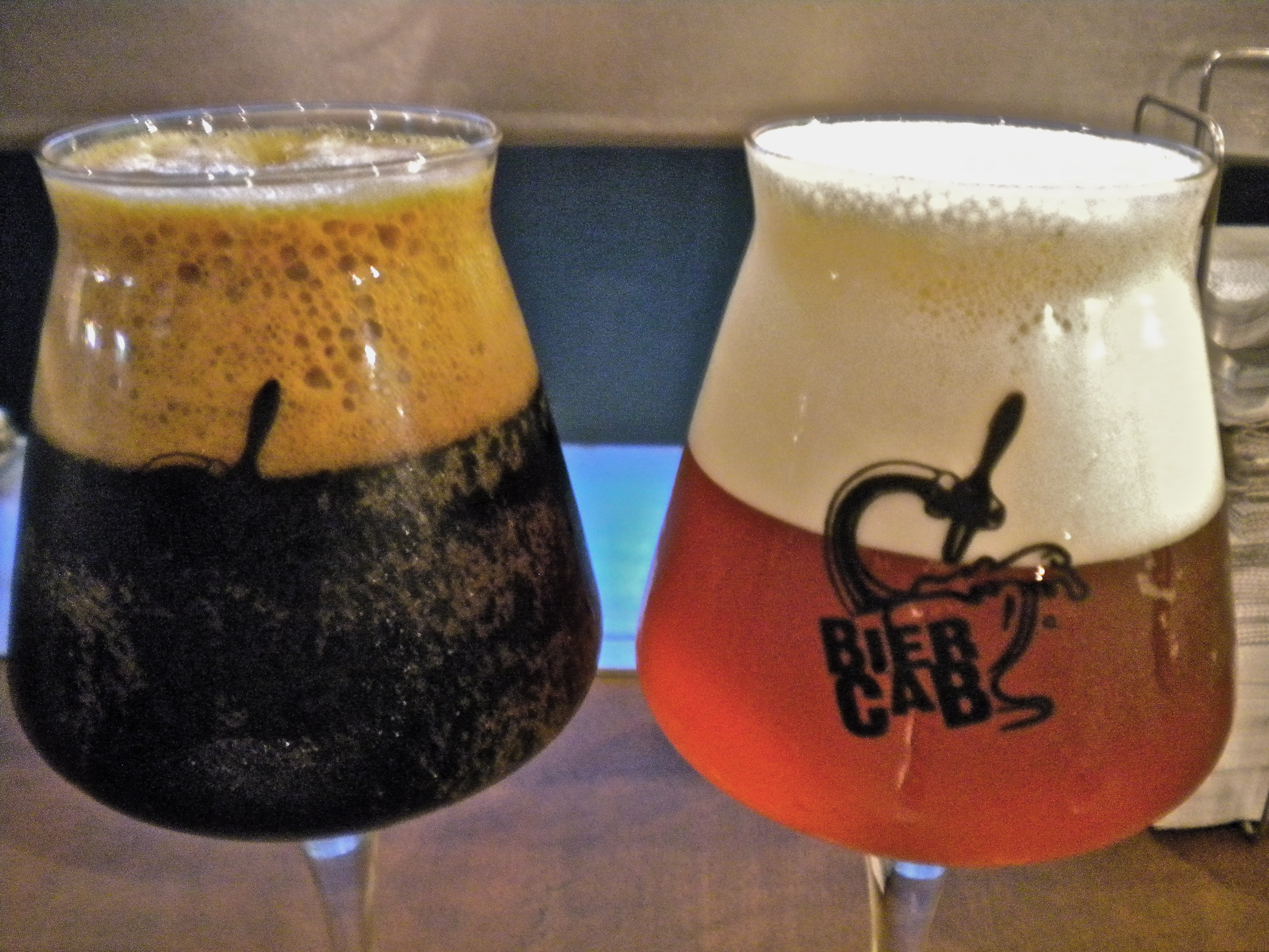
As soon as I abandoned the guidebook itinerary, Barcelona had a lot more to offer. I happily spent the next several days doing things that I would have done if I lived in the city year round. The town has a burgeoning craft beer scene, and a trip to BierCAB, a relatively new cervecería that has 30 beers on tap, was just what the doctor ordered after months of Cruzcampo. Sampling a range of home-grown Barcelona fruit ales, American Black IPAs and a deliciously sour Danish cuvée, I remembered precisely why big-city living is so addictive. I was also amused to find that the bartender, a genial bearded man with a high tolerance for foreigners mangling his language, was also from the south. When I explained that I lived in Jaén he let loose a torrent of furious and incomprehensible Spanish, from which I only managed to pluck out the phrases “only one type of beer”, “don’t know anything” and “terrible”. A visit to Fàbrica Moritz, the restaurant and micro-brewery that produces one of Barcelona’s most beloved beers, was similarly rewarding. The original Moritz was an Alsatian immigrant, and the restaurant pays homage to his heritage by melding traditional Spanish cuisine (patatas bravas, jamón Iberico), with typical northern French fare (flammenkuchen, rösti) with mouthwatering results.
BierCAB bounty

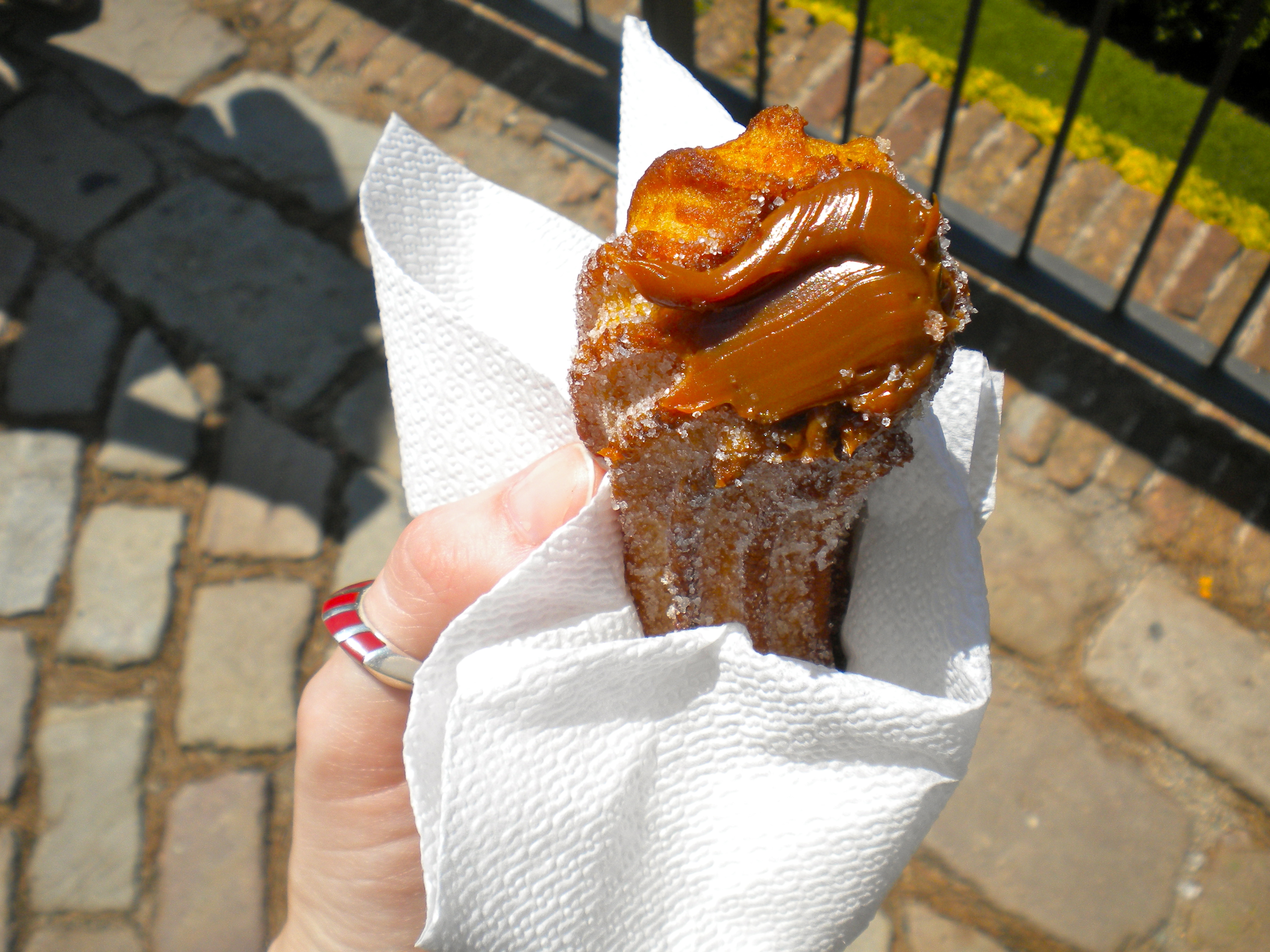
Since I am nothing if not an incorrigible glutton, I was likewise captivated by the city’s food markets. Even La Boqueria, an overwhelming, overpriced assault of color and sound, was well worth the visit. In true frugal graduate student fashion I bought nothing of substance except an apple, spending an hour wandering the stalls and gaping at all the purveyors had on offer, from meticulously molded marzipan candy to whole hocks of jamón Iberico. I made up for lost opportunities later that afternoon at Mercado Santa Caterina, only a twenty minute amble from the far more crowded and bustling Boqueria, sampling llaminets and amassing a collection of morcilla, fuet and manchego baixa en sal for a balcony dinner later that night. However, even the cornucopia of Barcelona’s neighborhood mercados could not prepare me for what I stumbled upon at the summit of Parc de Montjuïc. The entire amble from the Para-lel furnicular to the top of the hill was punctuated by whiffs of a scent that smelled tantalizingly like pancakes. When I arrived at the stock medieval market outside the castle gates, I finally identified its source: a stand devoted entirely to churros, sprinkled with cinnamon, rolled in sugar, dipped in chocolate and, most decadently, stuffed with caramel.

Caramel-filled churro outside of Castle Montjuïc

And so, my last afternoon in Barcelona, I wandered around the grounds of Montjuïc Castle contentedly festooned with diaphanous strands of escaped caramel, taking in the blinding glare of the sun over the Balearic as I watched freighter ships and passenger planes traverse the long stretch of cerulean water. I paused for a minute before heading back down the hill towards Poble Sec. Gazing north over the spires of the Olympic Park and out across the grandiose sprawl of the city itself, I was filled with a momentary regret that it had taken me so long to settle in and appreciate the all that Barcelona had to offer. However, I took comfort in the realization that even though my first visit got off to an rocky start, my second trip to Barcelona will be even better.
Posted in Travel, Travel Essay | Tagged , , , , , | 1 Comment

Osteology Everywhere: Pebble Edition

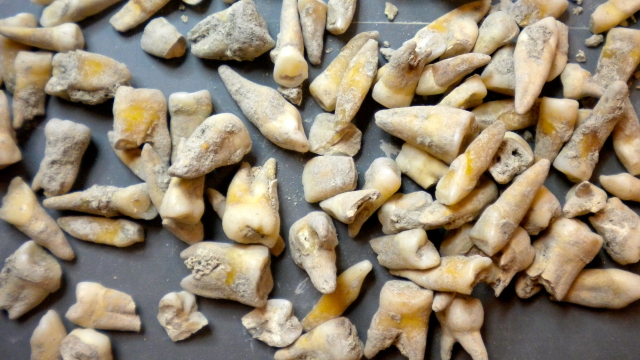
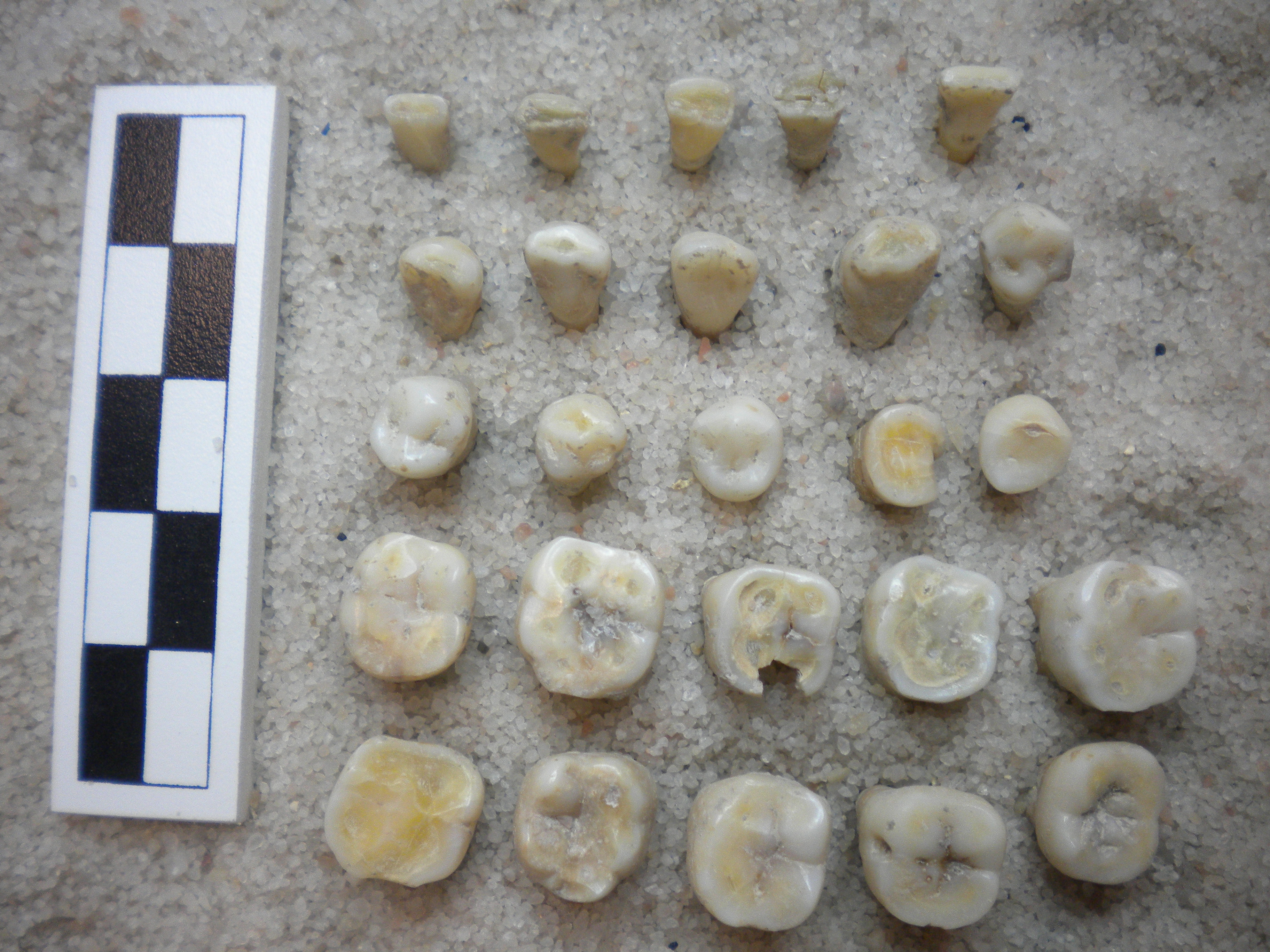
Yesterday afternoon I was staggering home from a nine-hour stint alone in the museum basement, when I was so struck by something I saw on the sidewalk that I went back to take another look. Now, to fill you in on my frame of mind lately, my days have been filled with things that look like this:

Opening a bag of loose dentition

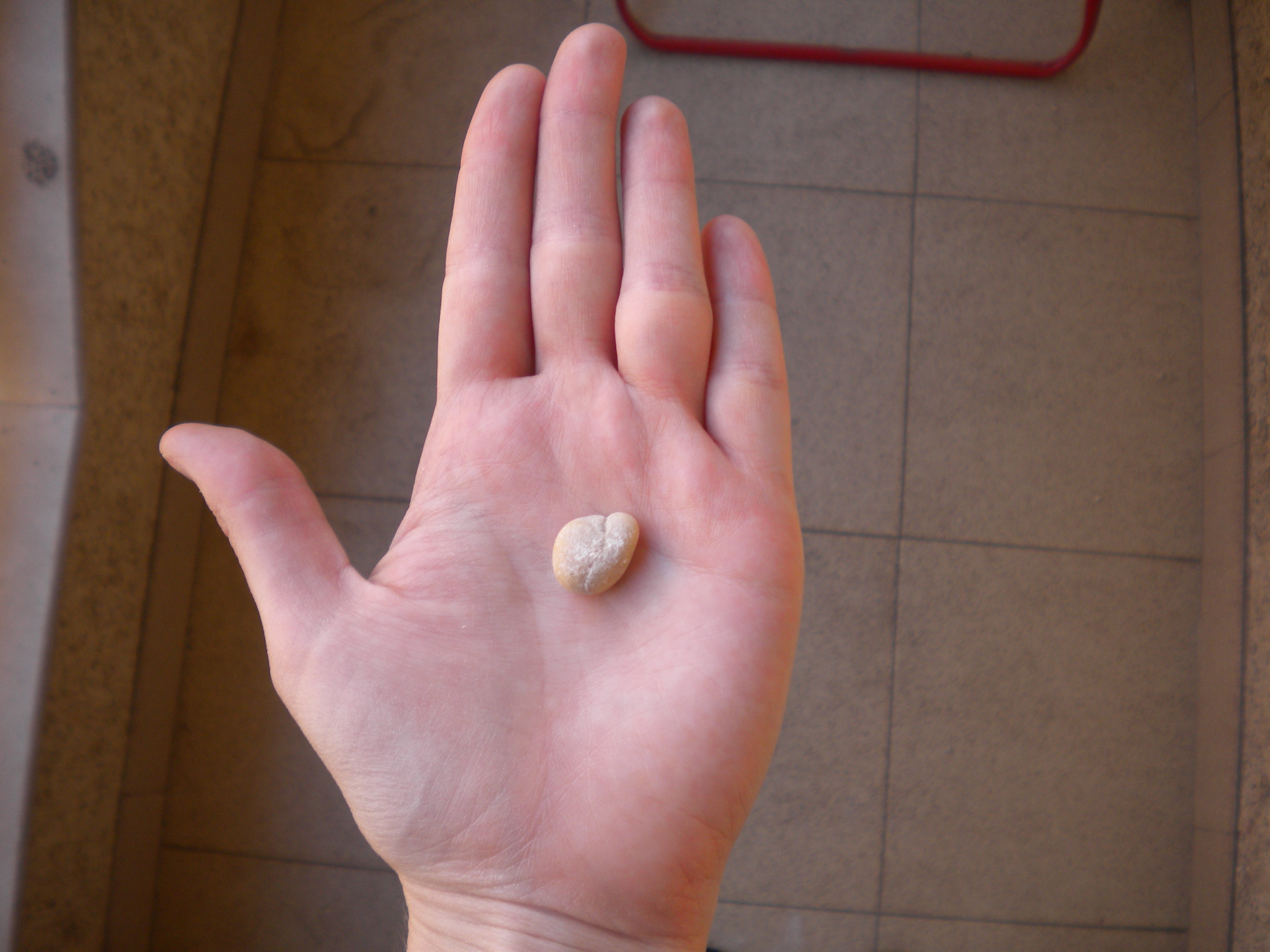
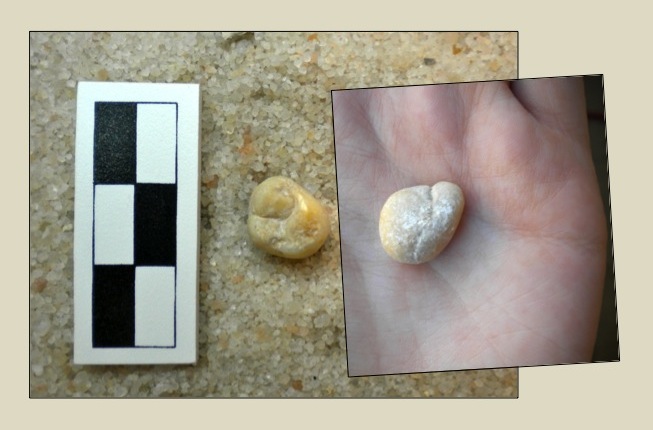
So it comes as no surprise that I immediately noticed the following pebble.

See it yet?

This pebble is clearly a worn upper third molar, with an enormous and bulbous protocone.

Can you tell that I’m starting to go a little dentition crazy? TGIF and have a great weekend everybody!

Image Credits: All photographs were taken at the Museo de Jaén in summer 2014.

Posted in Human Teeth, Osteology Everywhere | Tagged , , , , , , | 2 Comments

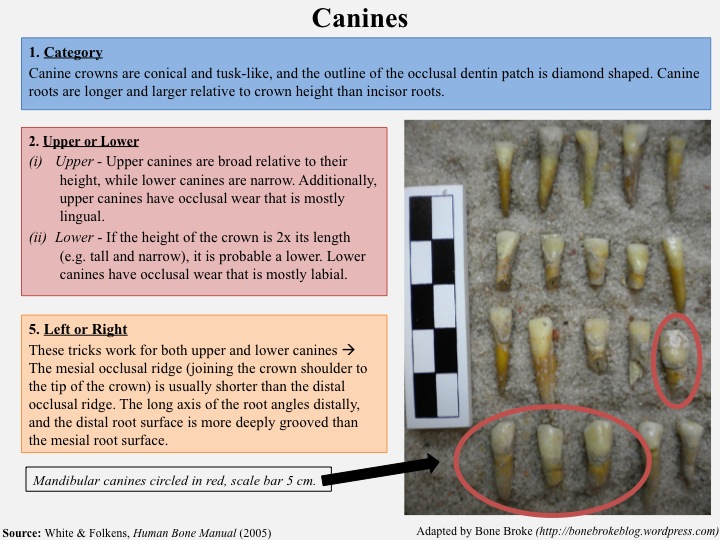
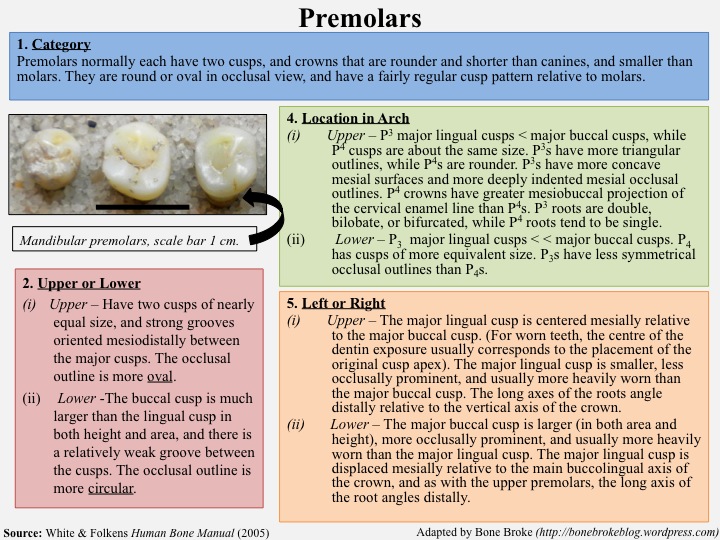
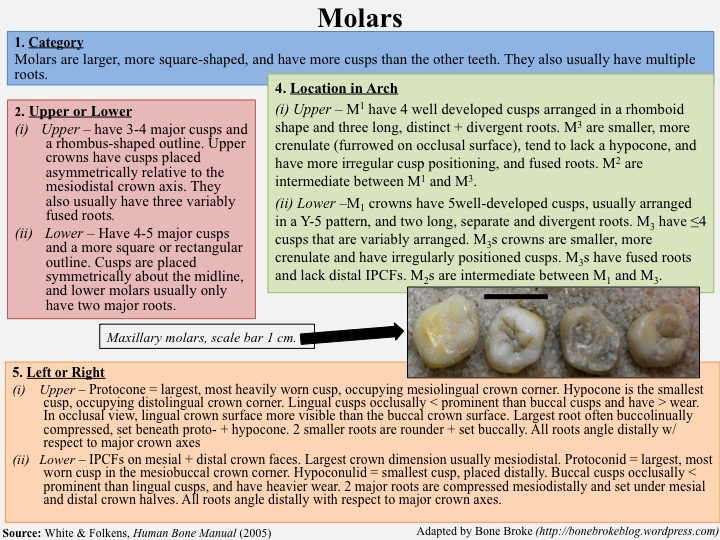
Identifying Human Teeth: Human Dentition Cheat Sheet

[Update: Eagle-eyed reader Paula M. noticed that a premolar text box was originally duplicated on the molar slide, throwing everything out of whack; this has been fixed on both the image file and pdf as of June 04, 2015. Please re-download!]

I took my first osteology class my second year of grad school. The evening before we were scheduled to have our preliminary tooth quiz, I found myself on a plane ride back from visiting family up north. I sat nursing a Coke Zero, furiously scouring White and Folkens Human Bone Manual and jotting down any scrap of information that would help me identify or side the enigmatic loose dentition I knew I would be confronted with the next morning. The middle-aged man sitting next to me watched me curiously for awhile, taking in my frazzled expression, stained clothing and messy hair, before finally biting the bullet. “I’m sorry to bother you,”, he said “but I just have to know. Are you a dental student?”.

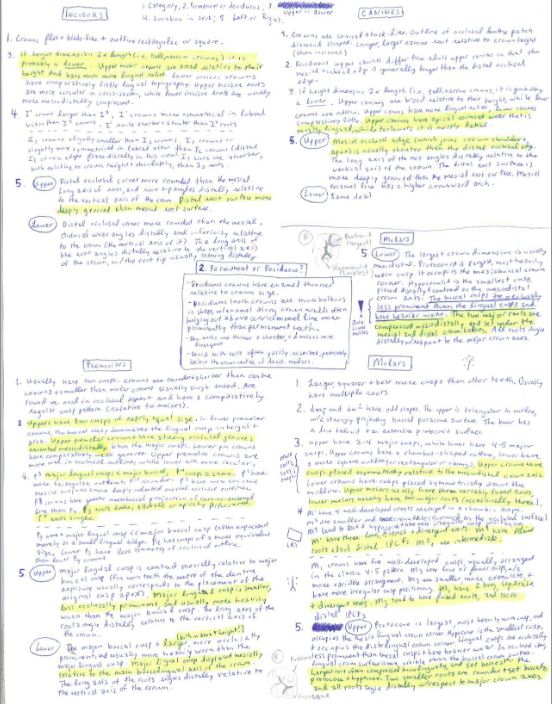
While the impression that I gave off that evening was misleading, the disorganized sprawl of a dental cheat sheet that I produced is actually something I’ve used quite frequently in the years since. At this point, it’s covered with pencil sketches of the occlusal surfaces of molars, hastily crossed-out swathes of scribbled notes about tooth roots, and irregular splotches of highlighter. While I always have the Human Bone Manual on hand, there are times when I don’t want to flip through the twenty pages on teeth when I’m trying to figure out something specific, like the directionality of wear on lateral incisors. Laziness, a detailed knowledge of the lay-out of my hand-written cheat-sheet, and the fact that I often don’t have the lap or table space available to flip through a book, have combined to make the cheat-sheet an analytical crutch for me. However, for anyone else, trying to navigate its tortuous organization and impenetrable short-hand is a feat akin to trying to decipher the Voynich Manuscript.

My original dental cheat sheet

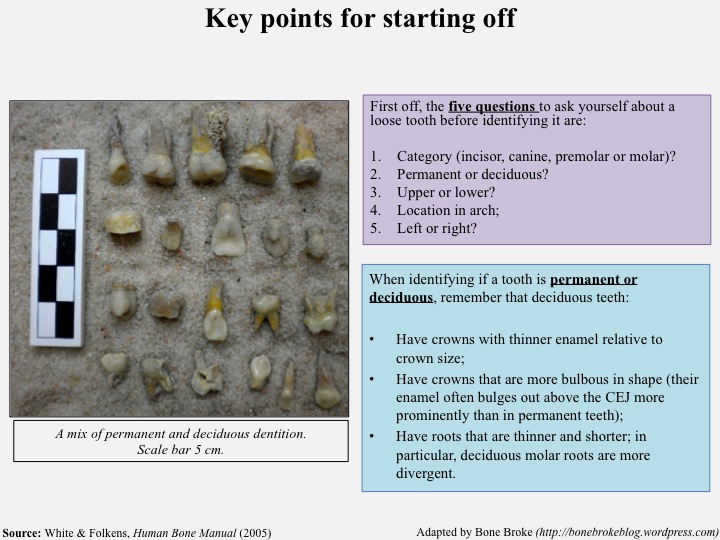
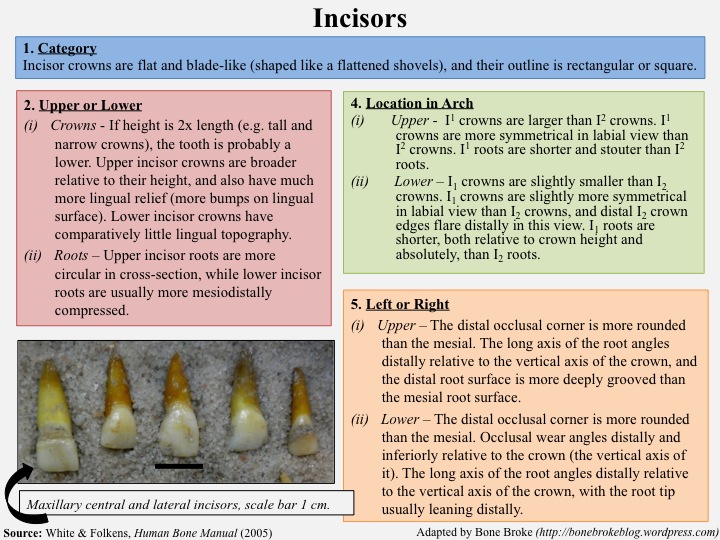
For the sake of my sanity, I’ve reconfigured my cheat-sheet into four neatly organized pages. All of the tips and techniques are cribbed from the Human Bone Manual, often-times copied out exactly. The only difference between this and what’s in the HBM is in the organization. Instead of having to hunt through multiple pages to find what you’re looking for, this organization provides all of the information each specific tooth category on one page. So, if you’re a budding osteologist and just learning your way around human teeth, it’s a useful supplement to the Manual itself. Know you’ve got a canine, but can’t tell if it’s an upper or a lower? Forget whether the wear on lower molars slopes lingually or bucally? This cheat sheet provides an easy way to answer those questions, so long as you know what category of tooth (e.g. incisor, canine, premolar or molar) you’re working with.

Key points for starting off

Incisors Canines Premolars

Bone Broke Human Dentition Cheat Sheet (Adapted from HBM 2005)

Or, if you’d prefer a printable pdf, you can download the following :

Bone Broke Human Dentition Cheat Sheet (Adapted from HBM 2005)

Note: Because I’m working on an enormous amount of loose human dentition right now (today’s work brought the tooth count for this necropolis up to 794, 78% of which have been loose), I’m going to be starting a series of posts called Identifying Human Teeth, that go into more detail about the differences between specific types of tooth categories. But for now, I’ll leave you with the broad-scale cheat sheet.

References:

White, T. D. and P.A. Folkens. (2005) The Human Bone Manual. Elsevier, Amsterdam.

Image Credits: All photographs were taken at the Museo de Jaén in summer 2014.

Posted in Human Teeth, Osteology | Tagged , , , | 11 Comments

Sevilla

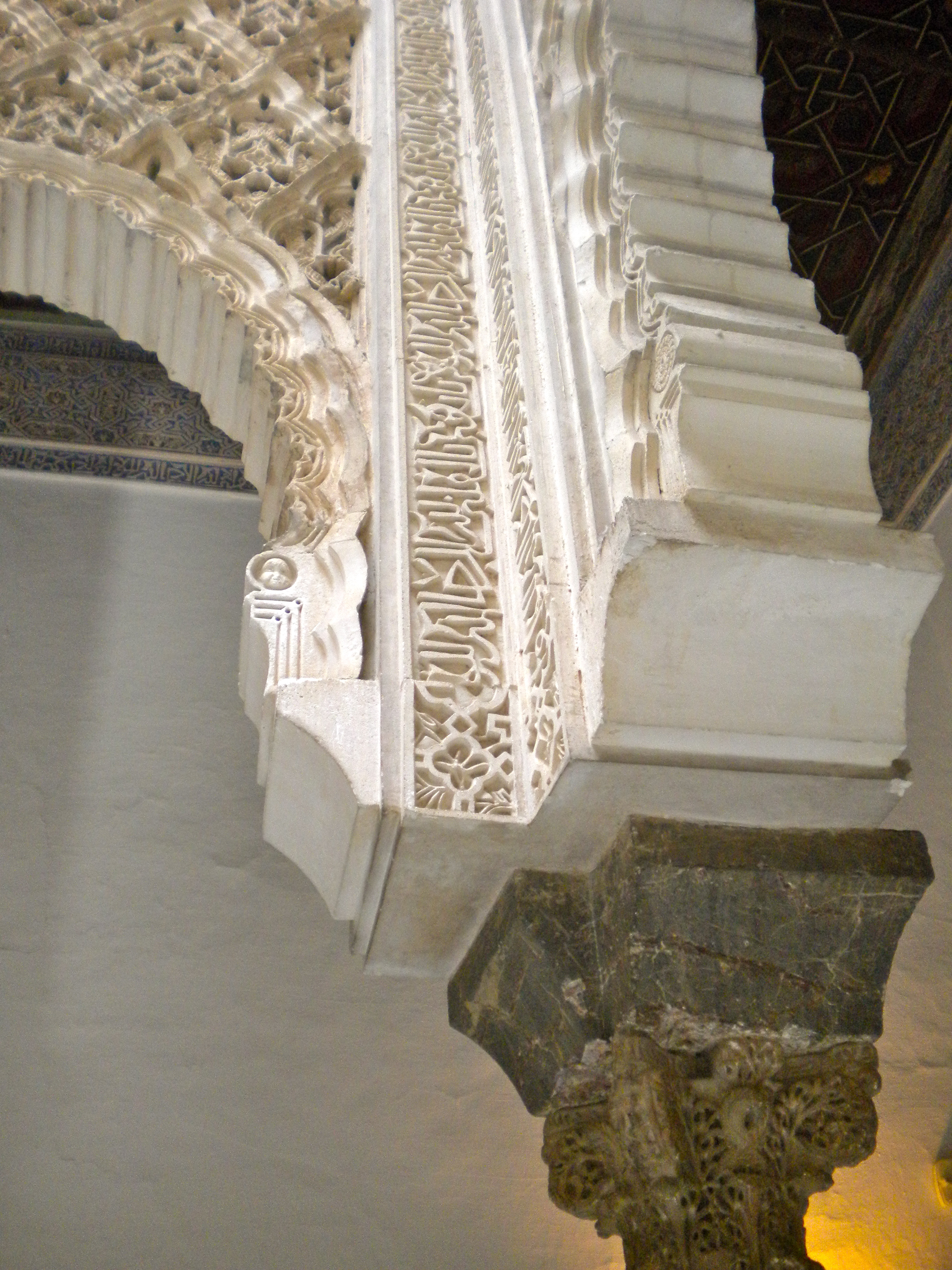
Alcázar arch
Trains in southern Spain are always flooded with light. The abundance of sun provides a sharp counterpoint to the blessedly cool Renfe air-conditioning. You often don’t realize how crisp the air is until you move through the train and are momentarily hit with a blast of stuffy outdoor heat in the accordion spaces between cars.

There are only two routes that have Jaén as their terminus: one heading north to Madrid’s bustling Chamartín station, the other veering west, to the sea-side city of Cadíz. I’d taken the Cadíz train on my way to Córdoba earlier this summer, but had never gone so far along the track. There was significantly more topography this far west. At one point we sped past an impressive castle on a small, high hilltop, its town spread out around the hillsides below, an urban skirt that had been shaken out and settled. We flashed past it at such a velocity that I had barely had time to noticed the castle was there before it vanished on the track behind us. Piecing my route together later I realized it must have been Almodóvar del Rio, an eighth century Muslim stronghold that rises up out of a curve in the train tracks about 25 kilometers south-west of Córdoba. At the next stop, an older couple boarded the train, faces and arms tanned leather by the sun. They carried taut plastic bags full of possessions, and hoisted a hamster cage in front of them as they navigated the narrow passage way. When they moved down the aisle, I saw that the cage held a tiny, quivering white puppy. Eyes wide with uncertainty, he whimpered for the first ten minutes of his ride, then sprawled across the bottom of the cage, fast asleep.

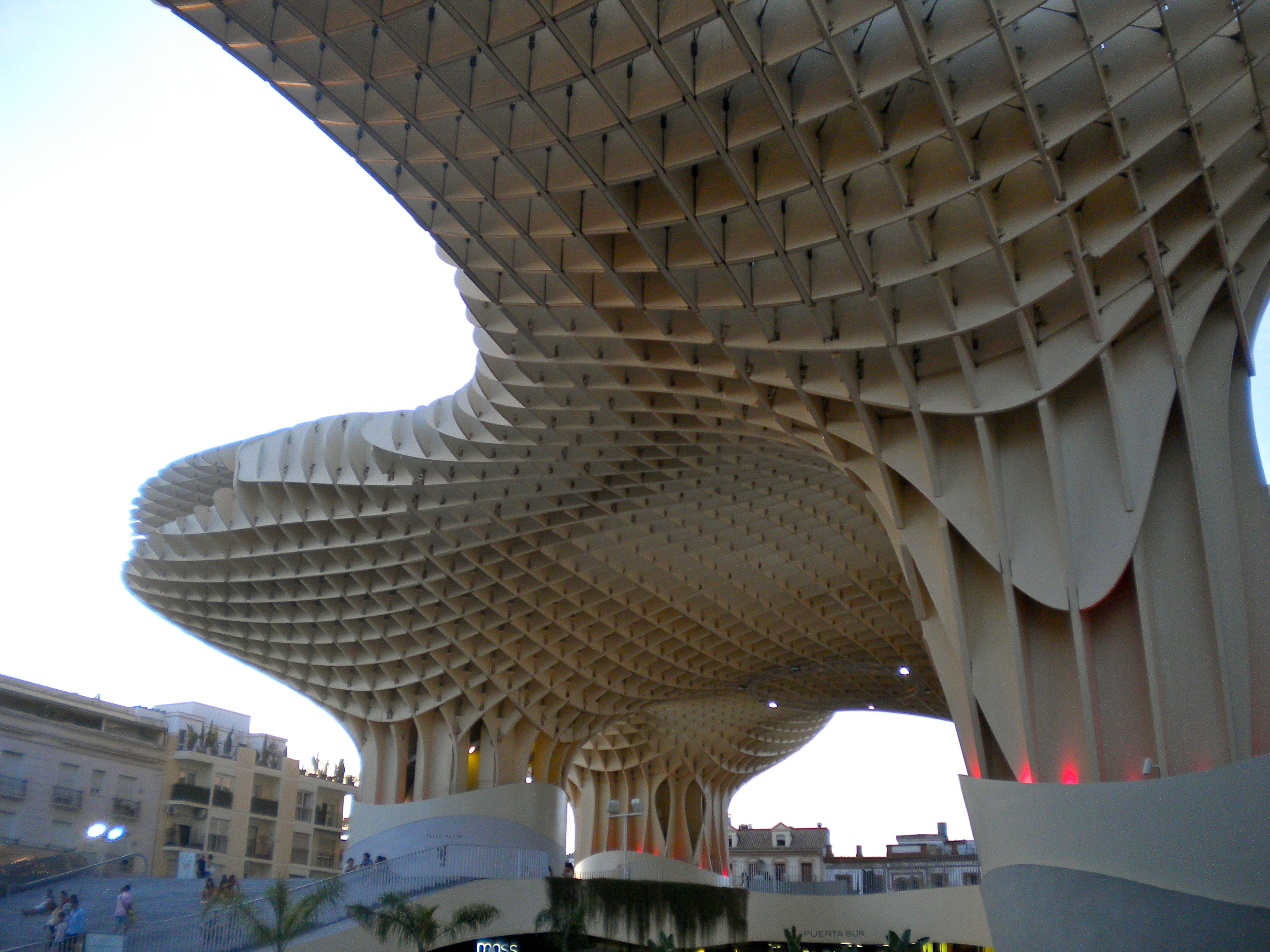
We arrived at Santa Justa in the late afternoon. After confusedly spilling off of the track into the streets, a friendly train-station employee helped me find my bearings, and we struck out for Calle José Leguillo. I realized immediately that Seville is a city in which the contemporary horizon battles for space with the much older strata lying underneath it. Glimpses of antiquity abound. Turn your head at an intersection with a modern-day pharmacy and Cruzcampo café-bar, and out of the corner of your eye you’ll see ancient walls erupting out of the entrepreneurial florescence of twenty-first century life. Nowhere is this more apparent than in Encarnación Square, where the undulating futuristic waves of the Metropol Parasol hunker contentedly amidst the ornate spires of sixteenth-century churches. Tellingly, the recently completed space-age structure is far more popular with the city’s younger crowd: shirtless young men one-up each other with bike tricks on its expansive terrace, and gaggles of well-dressed teenage girls swill sodas and text on its stairs and escalators.

Metropol Parasol
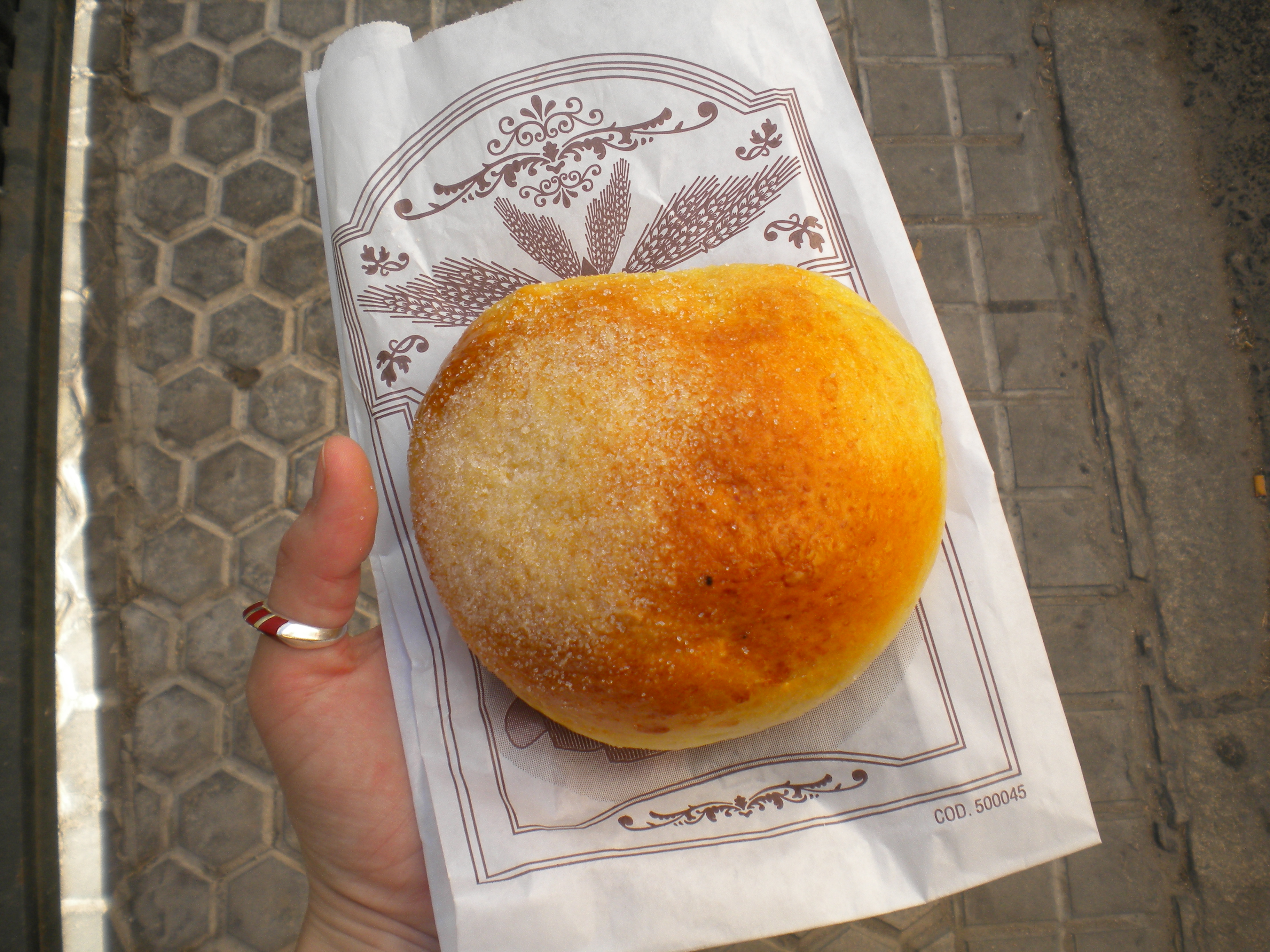
The next morning we set out for Plaza San Marcos, an easy place to find due to the consistency of its entrepreneurs: the square held not only Taberna Dos Leones de San Marcos, but also Farmacia San Marcos, Supermercado Bazar San Marcos and Drogueria San Marcos. Breakfast was a bollito de leche, carefully selected after a focused perusal of the square’s sole panaderia. These sweet, yeasted rolls are made with milk and painted with egg yolk. The dough is airy and fluffy, the top of the bun burnished with gold. Tearing off lightly sweetened chunks of bread, your fingers become adorned by the large granules of sugar sprinkled atop the bread as a finishing touch. My hands rapidly received a thick coating of the saccharine dust – it was difficult to eat attentively given the tortuous nature of the route that leads from Plaza San Marcos to the Catedral.

Bollito de leche

Tall, narrow, and winding, the alleyways of Barrio Santa Cruz are notorious for confounding visitors. Tripping along the cobblestone streets, shaded from the persistent sun by the sheer height of the surrounding buildings, you hear only the quiet echo of distant footsteps far behind you. Navigating the neighborhood, you feel temporarily caught outside of time, removed from the touristy hum of surrounding streets and lost in the urban equivalent of a sheltered grove.

Patio de las Muñecas
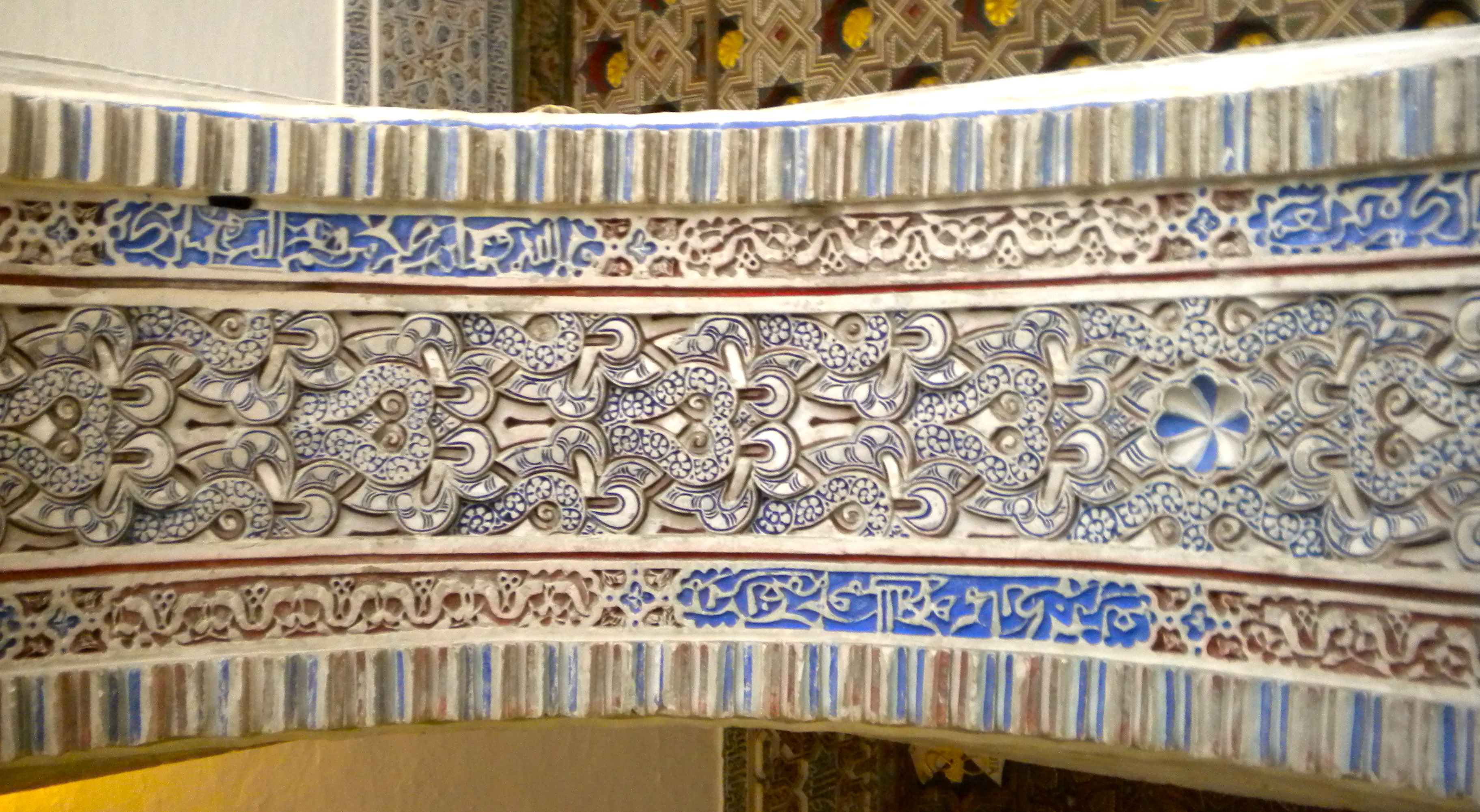
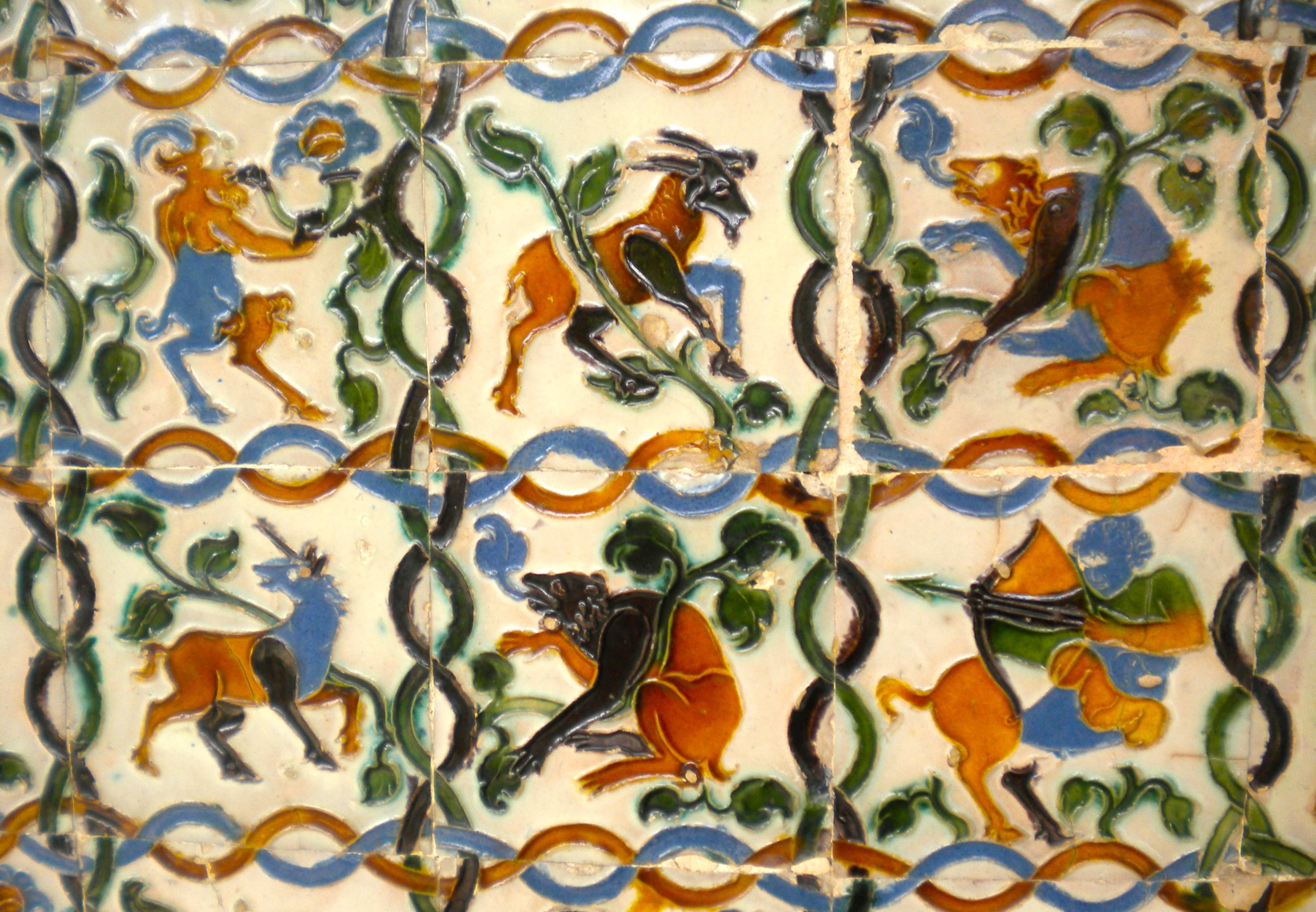
Santa Cruz finally relented and spit us out in front of the Alcázar, a sixteenth-century palace built to mimic the majesty of the Alhambra. It was predictably breathtaking, the intricacy of the architecture matched only by the sheer volume of people flooding its corridors. Islamic palaces in Andalucía are remarkable for their awesome detail; an entire visit can be spent in a single room, slowly taking in the decades of artisanship incarnated in ornate swirls of scriptured marble and brightly painted mosaics. Fully appreciating the aesthetic requires a gradual immersion, like lowering oneself into a cold pool in the heat of the summer. Stand in front of a wall and you are first aggressively assaulted by the sheer grandeur of it: height, symmetry, color, composition. Soon you realize that not a single surface has been left unattended to – every doorway is carved, every cornice embellished, every wall panel costumed in bright tile. The final epiphany comes in your appreciation of the most delicate details: the tiny dolls’ heads and nautilus shells nestled in the columns of the Patio de las Muñecas, the infinite tiled tessellations of the Patio de las Doncellas, the symmetrically oscillating hues of the menagerie decorating the walls of the Cenador de la Alcoba. These last glimpses belie the craftsmanship inscribed into the walls, the undaunted tenacity of artisans who spent years tenderly carving, sculpting and painting intimate details they knew most visitors would never notice or attend to.

After several hours of immersion in Mudéjar splendor, we ambled back out into the streets. Ominous clouds massed behind the cathedral, accenting the gothic grandeur of its weathered gray stone, the ornate Giralda spire and flying buttresses piercing the gathering storm. The weather was the result of the unseasonably cool temperatures – Seville in July is noted for its abominable, inhumane heat, normally sweltering in the low forties. We, however, were gifted with the summer low of only twenty-eight degrees.

Catedral

Bolstered by this unusual meteorological blessing, we spent the rest of the weekend traversing the city. First we struck out for the east bank of the Guadalquivir, strolling past the squat, tawny cylinder of the Torre del Oro, finally crossing the river at the Puente de Isabel II. The neighborhood on the opposite bank is named Triana, a lively quayside sprawl of houses, bars and restaurants that was just setting up for its feria, or celebration week, with a row of riverside tents serving beer and wine at all hours of the day and night. This area had a distinctly more local vibe. Well-dressed denizens ambled along the bustling thoroughfare of Calle San Cantio or relaxed in the shade of restaurant umbrellas for an afternoon beer, while small children raced around the streets, covered in ice cream. We returned the next day after a stroll through the expansive, bird-infested swathe of Parque Maria Louisa, watching the ongoing feria preparations from across the river over a plate of boquerones drenched in lemon juice. From the opposite bank it was clear that even the skyline silhouette of the city bristles with architectural contradictions, magnificent cathedral spires jostling for space with brand new apartment buildings, the gaudy 18th-century coloring of the Plaza de Toros underscored by the ascetic severity of the modernist sculptures decorating the river-bank in front of it.

DSCN9741

The tug-of-war between modernity and antiquity had also leaked into our own neighborhood. Elaborate, colorfully-roofed churches sprung up every few blocks and blue-lettered tiles still spelled out street names, but recent construction was eating up Calle San Luis. The entire center of the road had been gutted and surrounded with metal fencing and cautionary netting, a patient abandoned mid-operation still draped in stretcher sheets. This did not prevent locals from determinedly going about their business; despite the late afternoon hour, the neighborhood café-bar was still bustling. We walked in off the street, noticing an immediate drop in temperature in the concrete cool of the cerveceria. The proprietor was a cheerful, rotund man with a sun-creased face. He pushed up the shirtsleeves of his paper-thin blue button-up, set his hands staunchly atop the metal bar, and looked at me expectantly.

It was the ambiguous Spanish hour of siesta, that span of time that starts sometime late after lunch and stretches until at least seven at night, when some establishments are still open for business, but others are firmly and decidedly closed. There were still people in the bar, but it was clearly a neighborhood joint, where the line between friend and customer was blurred, if it existed at all. “¿Es possible de tomar una cerveza?” I inquired uncertainly. His face split into a grin. “¡Si, si, por supuesto es posible!” he chuckled, gently teasing me for my foreign timidity. He bustled off to fill small glasses with ice-cold beer, calling out “¿Algo mas?” as he levered the taps. When I asked for the bill he jotted the total in white chalk on the hammered tin countertop, then wiped it away immediately with a rag.

We caught the last train back to Jaén, forging north-east as dusk slowly settled over the landscape. The journey itself had been characterized by the full spectrum of Iberian light; the shadowed morning hour lost in the narrow streets of Santa Cruz, the eerie, midday darkness of a summer storm Plaza del Patio de Banderas, and the blinding assault of the late afternoon glare on the Calle San Luis. The return trip proffered one more example, as the sun gradually retreated across the country-side, soaking the rolling hills and squat olive trees with the last orange-gold vestiges of the day’s light.

Posted in Travel, Travel Essay | Tagged , , , , | 2 Comments